
TSMC Arizona explained: inside the Phoenix chip cluster
TSMC just pulled its second Arizona fab forward and is now committed to $265 billion in the state. Here is what is running in north Phoenix today, what is being built next, and what it means for jobs, water and power across Arizona and Nevada.
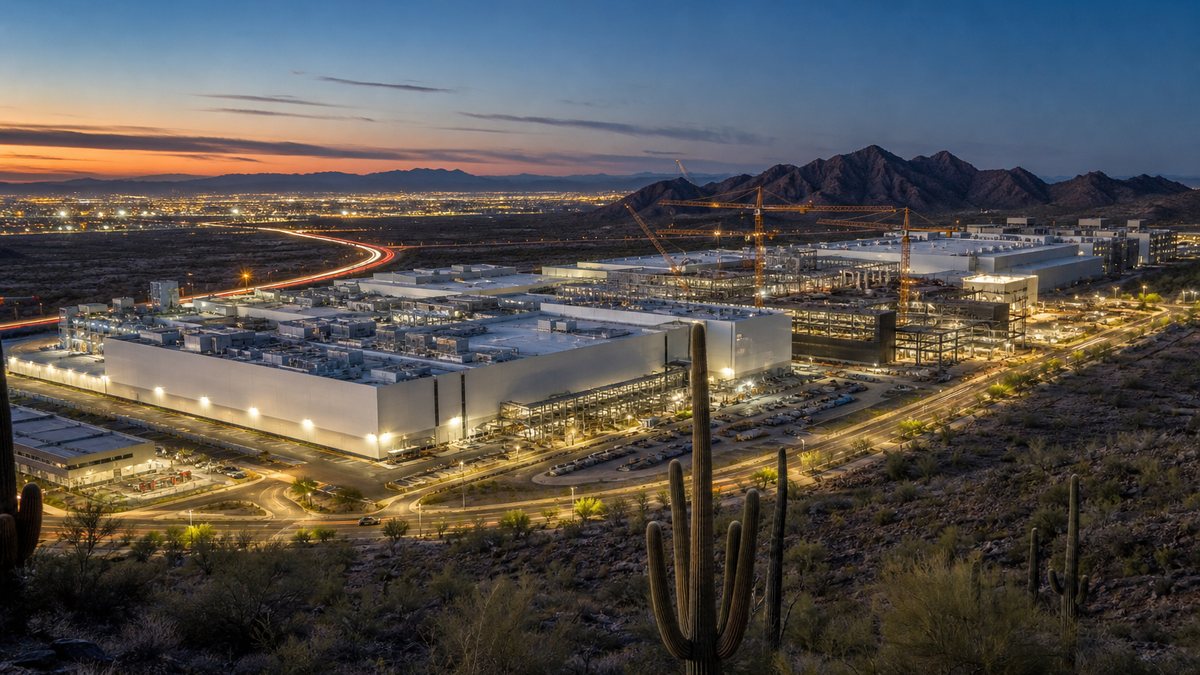
TSMC Arizona is the Taiwanese chipmaker's manufacturing campus in north Phoenix, near Loop 303 and Interstate 17. One fab has made 4-nanometer chips since late 2024. On October 15, 2026, TSMC said its second fab, built for 3-nanometer chips, will start volume production in the third quarter of 2027, slightly ahead of schedule. Announced investment now totals $265 billion.
- Latest news: On its October 15, 2026 earnings call, TSMC said Fab 2 construction is complete, tools are moving in, and 3nm volume production will begin in 3Q 2027 (AZ Big Media, Oct. 20, 2026).
- Money: $265 billion announced for Arizona after a further $100 billion pledge on July 16, 2026, which TSMC said will fund at least four more fabs for 2nm-and-below chips plus advanced packaging (Tom's Hardware).
- Running today: Fab 1 (4nm) entered volume production in late 2024; Nvidia marked the first U.S.-made Blackwell AI wafer there on October 17, 2025.
- Customers: Apple said in February 2026 it would buy more than 100 million chips made at TSMC Arizona in 2026 (Reuters via TrendForce).
- Jobs and water: More than 3,500 TSMC Arizona employees as of July 2026 (West Valley Post tracker). The site uses about 4.75 million gallons of water a day and recycles 65%, with a reclamation plant aiming for 90% or better by 2028 (AZFamily, Aug. 2026).
Six years ago, TSMC said it would spend $12 billion on one chip factory in Phoenix. Today the north Phoenix campus is described by local officials as the largest foreign direct investment in the country, with around 70 construction cranes on site, a working fab shipping chips to Apple, AMD and Nvidia, and plans for many more buildings. It is also the clearest test yet of whether the U.S. can make the world's most advanced chips at scale, and of whether a desert metro can supply the water, power and skilled people that takes.
This explainer pulls together the latest confirmed facts, separates them from company claims and projections, and looks at what the Phoenix chip cluster means for Arizona and for neighboring Nevada.
What is TSMC Arizona, and where is it?
TSMC (Taiwan Semiconductor Manufacturing Company) is the world's largest contract chipmaker. It does not sell chips under its own name; it manufactures them for companies such as Apple, Nvidia and AMD, which design them. TSMC Arizona is its U.S. subsidiary, and its campus sits at 5088 West Innovation Circle in north Phoenix, just north of Loop 303 and west of Interstate 17.
KJZZ, Phoenix's public radio station, described the campus in September 2026 as about 1,100 acres with one factory running and 11 more planned for manufacturing, packaging and other functions. TSMC also told shareholders in June 2026 that it had completed the purchase of a second large parcel near the campus, according to the West Valley Post's TSMC tracker. AZFamily reported that the newest expansion is planned on a 900-acre north Phoenix site.
TSMC Arizona's president, Rose Castanares, told KJZZ that Arizona will be the only location outside Taiwan with similar advanced chipmaking capabilities. She said the state's existing semiconductor ecosystem, which includes Intel, a large nearby university for recruiting engineers, and cooperation from state and city officials were the deciding factors.
What happened this month?
TSMC reported third-quarter 2026 results on October 15. According to AZ Big Media, revenue was $46.72 billion, up 41.2% from a year earlier, with a gross margin of 66.4%. Net income was NT$763.06 billion, up 68.7%. Advanced technologies made up 79% of wafer revenue, and TSMC guided fourth-quarter revenue to $52.3 billion to $54.3 billion while reaffirming a 2026 capital spending budget of $60 billion to $64 billion.
The Arizona headline from the call was timing. Chief executive C.C. Wei said of the second fab: "Volume production will begin in 3Q'27, slightly ahead of our previous schedule." In January 2026 the company had pointed to the second half of 2027, already earlier than the 2028 target it had given before. TSMC also said it is evaluating further U.S. expansion, including possible sites in Texas, but has made no decision.
On October 21, TrendForce, citing Reuters, reported again that the Arizona fab is expected to produce more than 100 million chips for Apple this year, chips Apple says go into iPhone, iPad and Apple Watch products.
Which fabs are running, and which are coming?
The federal government helped too: in April 2024 the U.S. Commerce Department awarded TSMC Arizona $6.6 billion in CHIPS Act grants and up to $5 billion in loans. The plan itself has grown in steps: $12 billion (2020), about $40 billion (December 2022), $65 billion, then $165 billion and six fabs (March 2025), and finally $265 billion (July 2026). A Bloomberg report cited by Tom's Hardware said the latest pledge implies a U.S. footprint of about 10 fabs and two advanced packaging facilities. Here is where each piece stands, based on TSMC statements reported by the sources listed below.
| Facility | Technology | Status (Oct. 2026) | Production timing |
|---|---|---|---|
| Fab 1 | 4nm (N4) | Operating | Volume production since late 2024 |
| Fab 2 | 3nm | Construction complete; tool move-in under way | Volume production 3Q 2027 (TSMC, Oct. 15, 2026) |
| Fab 3 | 2nm and more advanced (A16 cited) | Under construction; groundbreaking April 2025, topped out May 2026 | "Before the end of the decade"; 2029 previously cited |
| Fab 4 | To be announced | Early construction began in 2026 | No date published (2030 previously cited) |
| Fabs 5–6 and later | 2nm and below | Planned | Pace "depends on market demand," per TSMC |
| First advanced packaging fab | Advanced packaging | Early construction began in 2026 | No date published |
A note on the numbers: TSMC's dates are company targets. They have moved before in both directions. Fab 1 was held back by a shortage of qualified staff, while Fab 2 has now been pulled forward twice. Fab 4 onward has no published production date at all.
The important change this year is not another big dollar figure. It is that TSMC keeps moving its Arizona dates earlier rather than later. A 3nm fab in Phoenix running by the third quarter of 2027 would put Arizona only one generation behind Taiwan's newest production instead of two or three. That is the difference between a showcase plant and a real second home for leading-edge chipmaking.
Who buys chips made in Arizona?
Apple has been the anchor customer from the start. It received "tens of millions" of Arizona-made chips in 2025 and, in February 2026, said it would buy more than 100 million in 2026. Products cited include the A16 Bionic processor used in iPhone 15 models and the S9 chip for Apple Watch.
Nvidia gave the site its most symbolic moment. On October 17, 2025, Nvidia chief executive Jensen Huang signed the first Blackwell wafer produced in the United States at TSMC's Phoenix fab, calling it "the single most important chip" now being made in the U.S. Nvidia's blog noted that a wafer still has to go through further processing and packaging before it becomes a finished Blackwell AI chip. AMD has also had processors made there, including a Ryzen 9000-series CPU.
Why does advanced packaging matter so much?
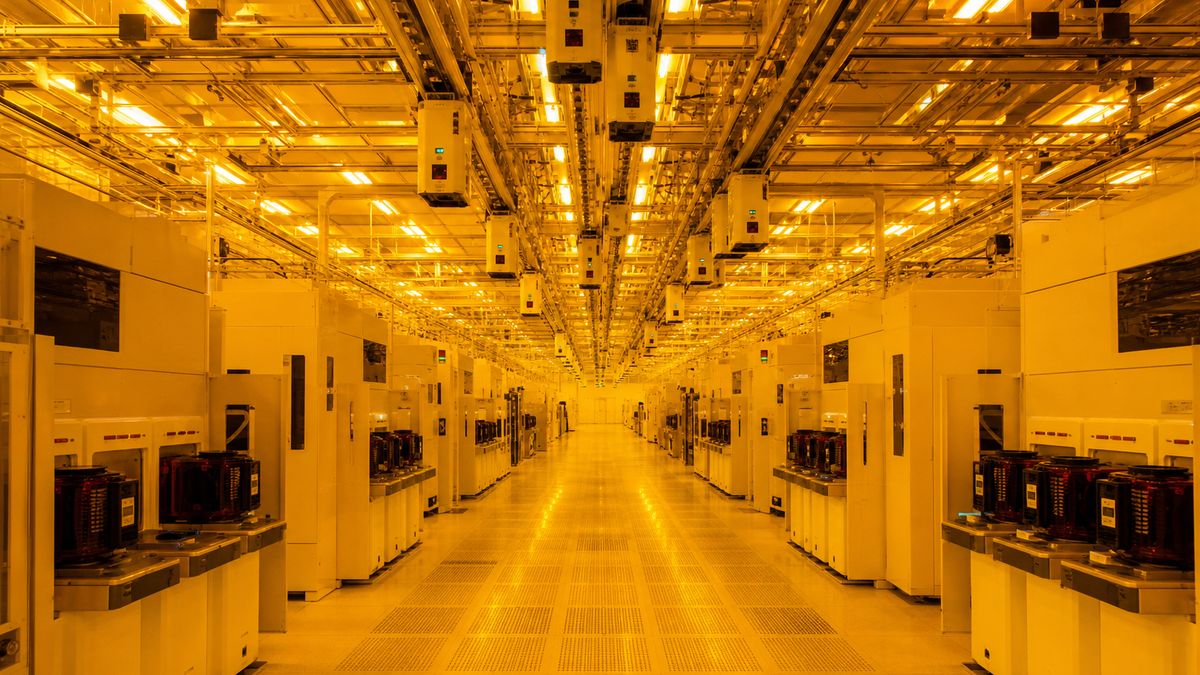
Until now, a chip made in Arizona has usually had to travel back to Asia to be packaged: cut from the wafer, stacked or joined with memory and other chips, and sealed into the part a server maker actually installs. For AI accelerators, that packaging step (TSMC's CoWoS technology, for example) is now a bottleneck in its own right.
Two projects aim to close that gap in Arizona. TSMC has begun early construction of its own first advanced packaging facility on the Phoenix campus. And Amkor Technology is building a packaging and test campus in Peoria, in the West Valley, with roughly $12 billion planned. The West Valley Post tracker reports Amkor's site grew to about 170 acres after a 67-acre addition in May 2026, with phase one production expected in early 2028. Amkor and TSMC signed a 10-year agreement in June 2026 to expand advanced packaging and test in Arizona, according to TrendForce and Amkor's investor release.
Smaller suppliers are following: the tracker lists Gudeng Precision opening a Glendale facility on October 6, 2026, and chemical-delivery specialist Cica-Huntek opening in Phoenix in July 2026. Industrial gas companies Linde and Air Liquide also supply the site.
How many jobs will the Phoenix chip cluster create?
Separate the confirmed numbers from projections here.
- Confirmed: TSMC Arizona reported more than 3,500 Arizona employees as of July 2026 (West Valley Post tracker). Its first U.S. recruiting class in 2021 was 250 people, according to the Greater Phoenix Economic Council.
- Company projection: In 2020, TSMC projected 1,900 full-time jobs for the original single-fab plan, a number long since overtaken.
- Outside estimates: Arizona State University economist Anthony Howell told AZFamily in July 2026 that the latest $100 billion could create 10,000 to 12,000 construction jobs and about 12,000 jobs once facilities operate. Economist Jim Rounds, who worked on a report for the Arizona Board of Regents, warned the state could be "short about 10,000 workers per year going forward."
- Other employers: supplier factories, Amkor's packaging campus and the 2,300-acre Halo Vista mixed-use development next to TSMC (groundbreaking March 2026) add more jobs, but no reliable combined total has been published.
The labor question has shadowed the project from day one. TSMC has said U.S. construction costs four to five times those of an identical plant in Taiwan and that it struggled to find qualified staff, sending U.S. hires to Taiwan for 12 to 18 months of training. Castanares told KJZZ the company is building a technician pipeline through community colleges and recruiting engineers from Arizona State University.
How much water does TSMC Arizona use?
Water is the question Arizonans ask most, given cuts to Colorado River supplies. In August 2026, TSMC engineers told AZFamily the facility uses about 4.75 million gallons of water per day, supplied through the City of Phoenix and described as mostly reclaimed wastewater with a little groundwater. Ultra-pure water is used to rinse particles and contaminants from wafers.
TSMC says it recycles about 65% of its intake, roughly 3.5 million gallons a day. Process water engineer Paige Bensen said that is about equal to the daily use of 12,000 homes. Sarah Porter, director of ASU's Kyl Center for Water Policy, estimated that about 15% of the remaining water, "maybe a little bit more," is lost to evaporative cooling.
TSMC broke ground in August 2025 on a 15-acre industrial water reclamation plant on the campus. Bensen said it will take reuse "from 65% reuse all the way to 90% reuse or better," but it is not expected to be fully operational until 2028. The site operates under a City of Phoenix industrial pretreatment permit. Porter said Phoenix weighed the trade-off and concluded, "We have enough water to do that." AZFamily also noted the expansion could make TSMC Phoenix's largest water customer.
| Water metric | Figure | Source / status |
|---|---|---|
| Daily water use | About 4.75 million gallons | TSMC engineers to AZFamily, Aug. 2026 |
| Recycled today | 65% (about 3.5 million gallons a day) | TSMC claim |
| Reuse target | 90% or better | TSMC target, plant due 2028 |
| Evaporation share | About 15% or a little more | Estimate by ASU's Sarah Porter |
Where does the power come from?
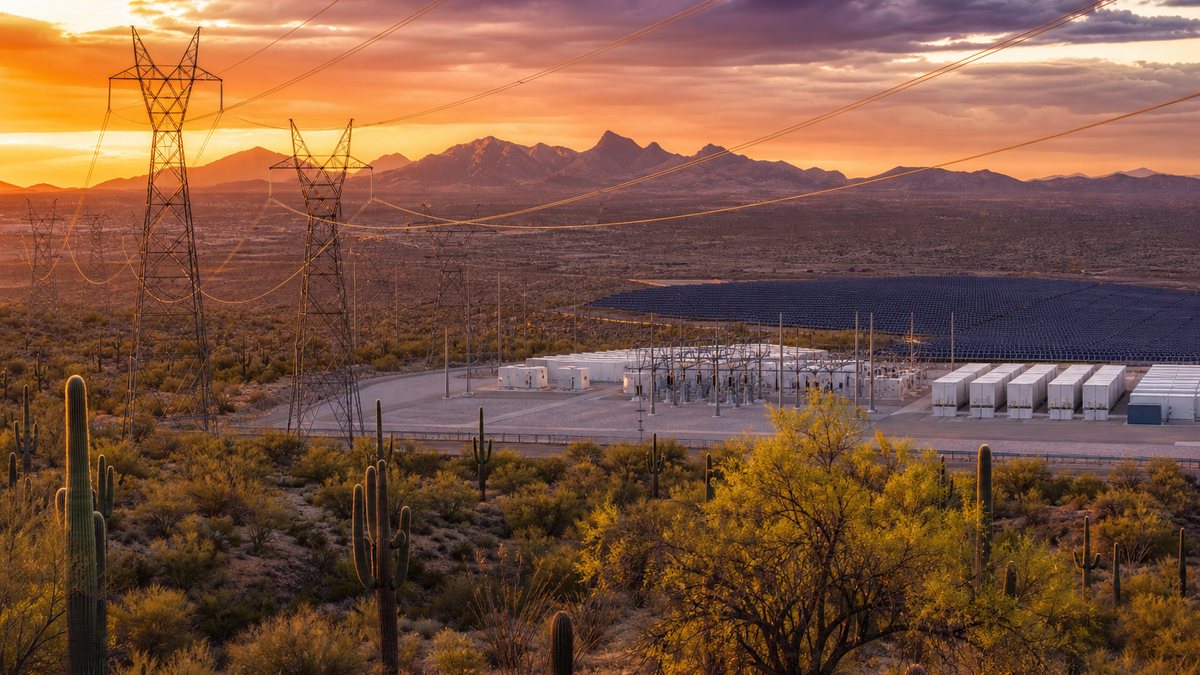
Arizona Public Service (APS) serves the site. In 2022, the Arizona Technology Council reported that APS was relocating 500 kV, 230 kV and 69 kV transmission lines to clear the roughly 1,100-acre TSMC and Linde site, building the new Avery substation and switchyard with an underground 230 kV line, and that phase one alone needed about 200 megawatts, which APS compared to the power for nearly 30,000 Arizona homes. TSMC is on APS's Extra High Load Factor rate, which requires a 92% minimum load factor: in plain terms, the plant runs flat-out around the clock.
That 200 MW figure covered only the first phase. Neither TSMC nor APS has published a current total load for the expanded campus, so any campus-wide number you see is an estimate. What is clear is that a fab cluster, plus the AI data centers growing around Phoenix, is pushing Arizona utilities toward new generation of every kind: solar and batteries now, and, as APS president Ted Geisler has said, nuclear options that would take more than a decade to develop.
Chip fabs are the ideal grid customer and the hardest one at the same time: they pay reliably and use power steadily, but they cannot tolerate even a flicker. In the desert that means pairing large solar plants with storage, firm generation and serious on-site resilience. Microgrids, backup storage and smart controls are not optional extras for this industry, and the utilities and engineers who solve reliability for fabs will shape how the whole Southwest grid is built.
What does TSMC Arizona mean for Nevada?
Nevada will not host a TSMC fab, but the Phoenix cluster still matters next door.
- Shared resources. Arizona and Nevada both draw on the Colorado River and sit on the same western power system. Large new industrial loads in Phoenix compete for the same water rules, transmission and new generation that Nevada's own growth depends on.
- The AI hardware chain. Chips made in Phoenix end up in AI servers, and Nevada is building those. On August 19, 2026, Hyve Solutions, a TD SYNNEX company that builds compute, storage and networking systems for AI and cloud, announced advanced manufacturing campuses in Reno (about 624,000 square feet) and North Las Vegas, with about 3,000 new jobs across both.
- Nevada's own chip foothold. The University of Nevada, Reno opened its NanoFab cleanroom in April 2025, which state economic development officials described as Nevada's flagship investment in the semiconductor and microelectronics supply chain. It offers lithography, deposition and etching tools for research, startups and workforce training.
- Data centers. Nevada's large data center campuses in Reno and Las Vegas are among the end users of the AI chips that Arizona is starting to make, and in Nevada the Las Vegas Review-Journal has reported on eight data center companies seeking a say in the state's long-term energy plan.
In short, Arizona is becoming the place where advanced chips are made, and Nevada is positioning itself as a place where the hardware that uses them is assembled and run. Both depend on the same scarce inputs: water, power and skilled workers.
What are the risks?
- Cost. TSMC has estimated U.S.-made chips cost at least 50% more than Taiwan-made chips. Who absorbs that, and for how long, depends on customers and on federal policy.
- Demand cycles. Wei said in July 2026 that he expects demand to stay very strong through 2029 or 2030 but added, "Whether there is a dip in between or not, I'm not very sure." TSMC has tied the pace of its later Arizona fabs to market demand.
- Workforce. Without enough technicians, engineers and construction trades, schedules slip, as they did for Fab 1.
- Water and power. The reclamation plant is not due until 2028, and campus-wide power needs have not been published.
- Geopolitics. ASU supply-chain expert John Fowler told KJZZ that tension between Taiwan and China is "the biggest threat to the industry." A U.S. production base is partly a hedge against exactly that.
What should we watch next?
- Fab 2 ramp: whether 3nm volume production starts in 3Q 2027 as promised.
- Fab 3 dates: when 2nm production in Phoenix gets a firm year.
- Packaging: Amkor's Peoria phase one (early 2028) and the start date of TSMC's own packaging fab.
- Water: progress on the reclamation plant and whether the 90% reuse target is met.
- Power: APS filings and new generation plans tied to the campus.
- Texas or elsewhere: whether TSMC's evaluation of other U.S. sites pulls future fabs away from Arizona.
Working on chips, power or water tech in Arizona or Nevada?
SHYNE covers the technology and energy projects reshaping the desert Southwest. Send us your story, project or announcement.
Email hgm@shyneltd.comFrequently asked questions
Where is TSMC Arizona located?
In north Phoenix, at 5088 West Innovation Circle, just north of Loop 303 and west of Interstate 17. KJZZ describes the campus as about 1,100 acres, and TSMC has bought additional land nearby.
How much is TSMC investing in Arizona?
$265 billion has been announced in total, after TSMC added another $100 billion on July 16, 2026. The pledge has grown from $12 billion in 2020.
What chips does TSMC make in Arizona today?
Fab 1 makes 4-nanometer chips and has been in volume production since late 2024. Customers include Apple, Nvidia, which marked its first U.S.-made Blackwell wafer there in October 2025, and AMD.
When will TSMC make 3nm and 2nm chips in Arizona?
TSMC said on October 15, 2026 that Fab 2 will begin 3nm volume production in the third quarter of 2027. Fab 3, for 2nm and more advanced chips, is under construction and expected to be operating before the end of the decade.
How many people work at TSMC Arizona?
More than 3,500 Arizona employees as of July 2026, according to a tracker of company disclosures. Economists estimate the latest expansion could support about 12,000 operating jobs, but that is a projection.
How much water does TSMC use in Phoenix?
About 4.75 million gallons a day, according to TSMC engineers in August 2026. The company says it recycles about 65% and expects to reach 90% or better when its reclamation plant is fully running in 2028.
Who provides electricity to TSMC Arizona?
Arizona Public Service. APS built a new substation and relocated transmission lines for the site, and said the first phase alone needed about 200 megawatts. No current campus-wide figure has been published.
Will TSMC package chips in Arizona?
Yes, that is the plan. TSMC has started early construction of its first advanced packaging facility, and Amkor is building a packaging and test campus in Peoria with phase one production expected in early 2028.
Is TSMC building a factory in Nevada?
No. TSMC's U.S. manufacturing is in Arizona, and it is evaluating other sites such as Texas. Nevada's link is through the AI hardware chain, including Hyve Solutions' planned Reno and North Las Vegas manufacturing campuses, and through shared water and power resources.
Are TSMC chips made in Arizona more expensive?
TSMC has estimated that U.S.-made chips cost at least 50% more to produce than chips made in Taiwan, and that building a plant in the U.S. costs four to five times as much.
Keep reading
Sources
- AZ Big Media, TSMC Arizona accelerates production timeline as earnings soar (Oct. 20, 2026).
- TrendForce, TSMC Arizona to supply 100M+ chips, citing Reuters (Oct. 21, 2026).
- Tom's Hardware, TSMC commits another $100 billion to Arizona for at least four more 2nm fabs (July 16, 2026).
- KJZZ, TSMC makes the world's most advanced computer chips. Why invest in Arizona? (Sept. 30, 2026).
- AZFamily, Arizona's chip footprint grows, but TSMC's water demand sparks questions (Aug. 24, 2026).
- AZFamily, Does Arizona have enough workers for TSMC's Phoenix expansion? (July 17, 2026).
- West Valley Post, TSMC Arizona & Supplier Tracker (accessed Oct. 21, 2026).
- NVIDIA, NVIDIA and TSMC celebrate first NVIDIA Blackwell wafer produced in the US (Oct. 17, 2025).
- Arizona Technology Council, Utility company makes progress on infrastructure for Taiwan Semiconductor project in north Phoenix (April 2022).
- Hyve Solutions via PR Newswire, Hyve Solutions selects Nevada for advanced manufacturing campuses in Reno and North Las Vegas (Aug. 19, 2026).
- University of Nevada, Reno, Sen. Rosen welcomes semiconductor manufacturing to Nevada (2025).
- Las Vegas Review-Journal, These 8 data center companies want a say in Nevada's energy future.
- Wikipedia, TSMC Arizona (investment history, CHIPS Act award, cost and customer background).
SHYNE reports on technology and energy for general information. Timelines, investment totals and targets are as stated by the companies and sources listed and may change. Nothing here is investment advice.