
Air taxis in Arizona: SB 1307, vertiports and when eVTOLs will really fly
Arizona wrote electric air taxis into state law in 2025 and its transportation department says it has met the first deadlines. This week, the two U.S. front-runners pushed their first passenger flights to 2027. Here is what the law does, what is actually flying, and where Nevada fits.

Air taxis in Arizona are legal to plan for but not yet carrying passengers. Senate Bill 1307, signed in May 2025, made ADOT plan for vertiports and electric-aircraft charging from Sept. 1, 2026. No eVTOL has an FAA type certificate yet, and Joby and Archer said in November 2026 that their first passenger operations will slip into 2027.
- State law: SB 1307 (Laws 2025, Chapter 185) was signed by Gov. Katie Hobbs in May 2025 and took effect on Sept. 26, 2025 (Snell & Wilmer, Sept. 8, 2025).
- The deadline: from Sept. 1, 2026, ADOT must include public vertiports and electric-aircraft charging stations in the State Aviation System Plan. ADOT says it has met that requirement and named an AAM planner; its plan appendix is "expected to conclude in fall 2026" (ADOT).
- Federal pilots: the FAA picked eight eVTOL Integration Pilot Program projects on March 9, 2026. None is led by Arizona or Nevada, but Joby says Utah's project includes testing in Arizona (FAA; ABC15, March 16, 2026).
- Timeline slip: on Nov. 4 Joby said initial commercial operations under the pilot program are now expected in 2027; Archer's CEO said he plans to be Midnight's first passenger "in 2027" (AVweb, Nov. 12, 2026).
- Certification: as of March 2026, the FAA had not type-certificated any piloted electric aircraft for commercial service, according to a GAO report (via The Flight Brief, May 2026).
For a few years, "flying taxis over Phoenix" was a marketing line. In 2025 Arizona turned it into a planning duty. A short state law now requires the Arizona Department of Transportation to treat vertiports, the small landing pads that electric vertical takeoff and landing (eVTOL) aircraft need, as part of the state's aviation system, alongside runways and terminals. It also limits how far cities and towns can go in writing their own rules for these aircraft.
The aircraft themselves are another matter. The two American companies closest to service, Joby Aviation and Archer Aviation, have not received FAA type certificates, and in the first half of November both said that their first passenger flights, previously expected in 2026, will happen in 2027. That gap between Arizona's readiness on paper and the aircraft's readiness in the air is the real story. Below, we separate what the law and the regulators have confirmed from what the companies say will happen next.
What is an eVTOL air taxi?
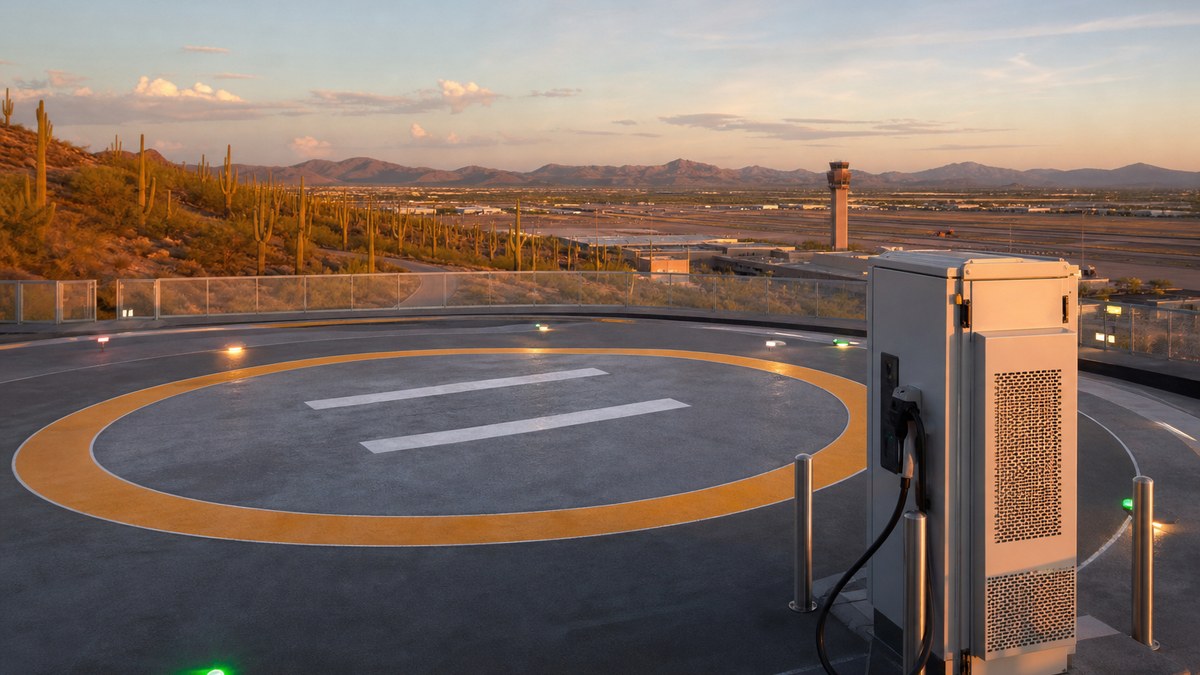
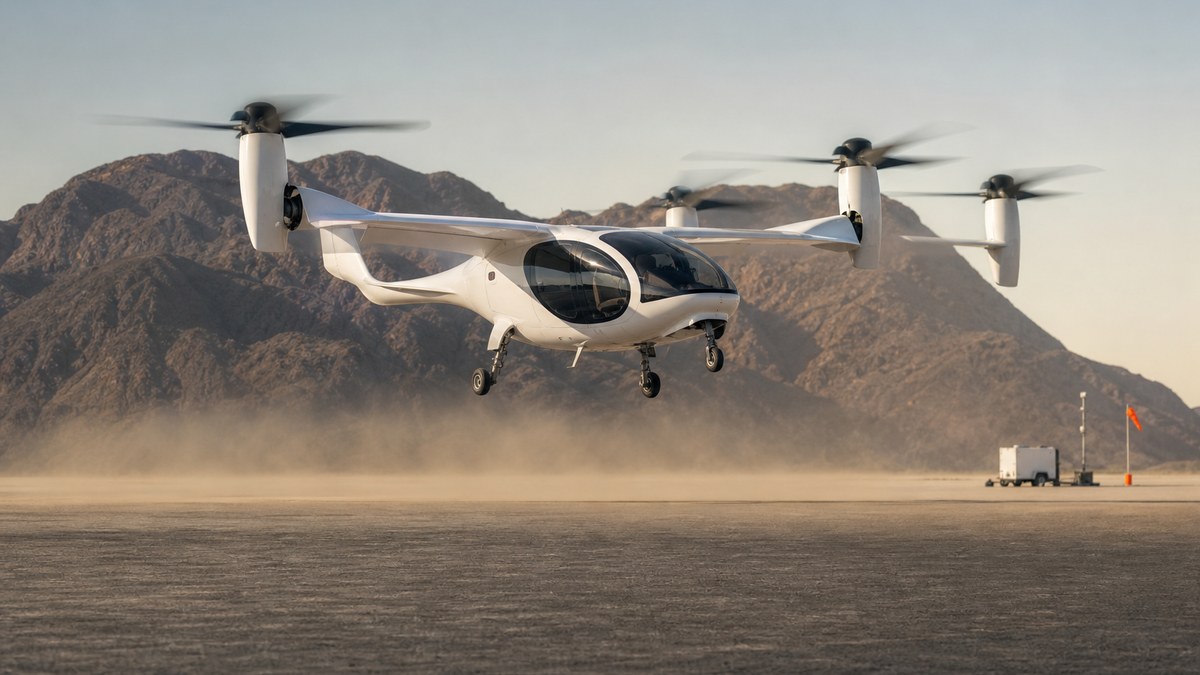
An eVTOL is a battery-electric aircraft that takes off and lands vertically like a helicopter, then flies forward on wings or tilted rotors like a small plane. The leading U.S. designs carry a pilot and up to four passengers. Because they use many small electric motors instead of a single turbine, the companies say they are quieter and cheaper to run than helicopters. Those claims have not yet been proven in commercial service, because none of the aircraft has entered it in the United States.
Arizona's new law uses broader language. It defines three types of aircraft under the heading of advanced air mobility (AAM): electric conventional takeoff and landing aircraft (eCTOL), eVTOL aircraft, and "powered lift," the FAA category that covers aircraft which lift off like helicopters and cruise like airplanes, according to ADOT's summary of the statute. That matters because some of the first electric aircraft to fly passengers or cargo regionally may use ordinary runways rather than vertiports.
What does Arizona's SB 1307 actually do?
SB 1307 is short, and most of what it does is planning and coordination, not funding or construction. According to an analysis by Phoenix attorneys Patrick J. Paul and Sukhmani Singh of Snell & Wilmer, published Sept. 8, 2025, and ADOT's own program page, the law:
- Adds an "Advanced Air Mobility Infrastructure" article to Title 28 of the Arizona Revised Statutes, the transportation title.
- Requires ADOT, starting Sept. 1, 2026, to incorporate advanced air mobility into the State Aviation System Plan, including public vertiports and electric-aircraft charging stations, in consultation with airports, air carriers, the FAA and others.
- Requires ADOT to designate an advanced air mobility specialist to help local governments with planning, zoning and permitting.
- Has the Arizona Commerce Authority provide guides and technical materials (per Snell & Wilmer).
- Stops local governments from creating rules on aircraft operations that conflict with the framework, while airports keep some of their own authority.
| Item | What it says | Status (Nov. 2026) |
|---|---|---|
| SB 1307 signed | Laws 2025, Chapter 185 | Signed May 2025; effective Sept. 26, 2025 |
| Vertiports and charging in state aviation plan | Required from Sept. 1, 2026 | ADOT says requirement met; AAM appendix due to conclude fall 2026 |
| State AAM specialist | ADOT must designate one | ADOT says an AAM Planner was named in its Aeronautics Group |
| Local rules | No conflicting local rules on aircraft operations | In force since Sept. 26, 2025 |
| Statewide AAM strategic plan | Not required by law | ADOT "anticipates pursuing" one; no date |
Sources: Snell & Wilmer (Sept. 8, 2025); ADOT Advanced Air Mobility page (checked Nov. 2026). ADOT's status statements are the agency's own account.
What the law does not do is just as important. It does not pay for any vertiport, approve any route, or certify any aircraft. Airspace, pilots and aircraft remain federal responsibilities under the FAA. The state's job is to make sure that when the aircraft are ready, Arizona's airports and cities know where they could land, how they would be charged, and who to call for permits.
SB 1307 is a sensible, low-cost law. It asks the state to plan, not to spend, and it gives the industry one set of local rules instead of a patchwork of city-by-city rules. Its weakness is that planning documents age quickly. The aircraft, charging standards and federal rules are all still moving, so the real test is whether ADOT updates its AAM work every year or treats the fall 2026 appendix as the finished job. The second most useful thing the state could do is publish where the grid can actually support megawatt-scale aircraft charging, because that will decide where vertiports go far more than zoning will.
Has ADOT met the Sept. 1, 2026 deadline?
According to ADOT, yes. Its advanced air mobility page says the department "has already met both of these requirements": it has designated an AAM Planner within the Aeronautics Group, and it is incorporating AAM into the State Aviation System Plan through a dedicated appendix, which it expects to conclude in fall 2026. The contact listed is Jeff Webbe, ADOT's AAM Planner. The page also says ADOT "anticipates pursuing a statewide AAM strategic plan," without a timeline.
Two caveats. First, this is the agency describing its own compliance; we did not find an independent review. Second, the appendix had not been published in final form when we checked, so the details that matter most to cities and airports, such as which sites are suitable for vertiports and what electrical capacity they would need, are not yet public. That is the document to watch for over the coming weeks.
Is Arizona part of the FAA's eVTOL pilot program?
Not as a lead. On March 9, 2026, Transportation Secretary Sean Duffy and the FAA announced eight selections for the Advanced Air Mobility and eVTOL Integration Pilot Program (eIPP), created under the June 2025 executive order "Unleashing American Drone Dominance." The FAA said it received more than 30 proposals and that the eight projects span 26 states. The leads named were the Port Authority of New York and New Jersey, and the transportation departments of Texas, Utah, Pennsylvania, Louisiana, Florida and North Carolina, plus the City of Albuquerque. Neither Arizona nor Nevada was named.
Arizona does come in through the side door. Joby, which is a partner in Utah's multi-state project, told the Phoenix Business Journal (republished by ABC15 on March 16, 2026) that it will test in a "wide range" of environments across the Western U.S. and Arizona, including urban areas, rural corridors, mountain terrain and wildfire-prone regions, as part of Utah's uFLY initiative. Joby did not name a city or airport in Arizona, and we have not found public dates for flights in the state. Treat it as a company plan, not a scheduled event.
| eIPP lead (March 9, 2026) | Focus | Aircraft partners named by FAA |
|---|---|---|
| Port Authority of NY & NJ | Passenger flights incl. Manhattan heliport | Archer, BETA, Electra, Joby |
| Texas DOT | Dallas, Austin, San Antonio, later Houston | Archer, BETA, Joby, Wisk |
| Utah DOT (multi-state) | Pacific Northwest, Rockies, Oklahoma; Joby says incl. Arizona | Ampaire, BETA, Joby, others |
| Pennsylvania DOT | 13-state collaborative, small-community routes | BETA, Electra, others |
| Louisiana DOTD | Gulf cargo and energy-site flights | BETA, Elroy Air, others |
| Florida DOT | Cargo, passenger, automation, medical | Archer, BETA, Electra, Joby, others |
| North Carolina DOT | Medical and regional, autonomy into Virginia | BETA, Joby, others |
| City of Albuquerque | Autonomous operations | Reliable Robotics |
Snell & Wilmer argued in 2025 that passing SB 1307 would make Arizona more attractive as a host site for the pilot program. That did not translate into an Arizona-led project in the first round. Arizona's realistic route into early operations is therefore as a test environment within another state's project, or as a later market once aircraft are certified.
When will Joby and Archer actually fly passengers?
Not in 2026. AVweb reported on Nov. 12, 2026 that both companies had moved their first passenger operations into 2027. Here is what each said, all of it company guidance:
- Joby had planned passenger operations under the pilot program before the end of 2026. In its Nov. 4 shareholder letter and earnings call, it said it had completed several certification tests and expects FAA pilot training and more company flight testing in the first half of 2027, steps that come before Type Inspection Authorization (TIA) flight testing with FAA pilots. Chief Policy Officer Greg Bowles said commercial flights under the program "will be tied to substantial TIA flight testing." CFO Rodrigo Brumana said initial commercial operations under the program are expected in 2027. Joby has flown demonstration flights in Texas and Florida under the program and has not given a date for its type certificate.
- Archer said its Midnight aircraft received an FAA Market Survey Special Airworthiness Certificate, which allows piloted runway demonstrations in Los Angeles. Before it can seek a similar approval for vertical operations, Archer still has to complete a piloted transition from vertical to wing-borne flight, which it targets before the end of 2026. CEO Adam Goldstein said on Nov. 9: "In 2027, I plan to be Archer's first passenger in Midnight." Archer has long said it intends to offer air taxi service for the 2028 Los Angeles Olympics.
The key point is that a market-survey or demonstration certificate is not a type certificate. A type certificate is the FAA's approval that a design meets its safety standards, and it is required before routine paid passenger service. A May 2026 GAO report, as summarized by The Flight Brief, found that as of March 2026 the FAA had not type-certificated any manned electric aircraft for commercial operations, and that Joby and Archer were the only two of 14 eVTOL projects with special-class airworthiness criteria issued.
How close are they to certification?
Each company reports progress using its own stages, so the numbers are not directly comparable. The figures below are company-reported and dated:
| Company | Latest public progress | Date and source |
|---|---|---|
| Joby (5 FAA stages) | Stage 4: 82% complete on Joby's side, 75% FAA side. Stage 5: 15% Joby, 6% FAA. First FAA-conforming aircraft for TIA flying | Data to May 1, 2026, Q1 shareholder letter (via The Flight Brief) |
| Joby, latest guidance | FAA pilot training and more flight testing in H1 2027 before TIA flight testing; first eIPP commercial ops 2027 | Nov. 4, 2026 (via AVweb) |
| Archer (4 FAA phases) | Says it closed Phase 3 in April 2026, Phase 4 under way; FAA accepted 100% of means of compliance (March 2026) | Q1 results, May 11, 2026 (via The Flight Brief) |
| Archer, latest guidance | Market Survey certificate for runway demos in LA; piloted transition targeted by end of 2026; first passenger flight 2027 | Nov. 2026 (via AVweb) |
Accepting a "means of compliance" means the FAA agrees on how a requirement will be shown; it does not mean the tests have been passed. The stage that matters most for timing, TIA flight testing with FAA pilots, is still ahead for Joby, according to its November guidance.
A one-year slip is not a collapse; it is what new aircraft certification normally looks like. But it should reset expectations in the Southwest. The first eVTOL flights most Arizonans and Nevadans see are likely to be tests and demonstrations, not a ride-hailing app with a "fly" button. For cities, that is useful breathing room: the time to sort out noise rules, vertiport sites and grid connections is before an operator arrives with a launch date, not after. For investors and boosters, it is a reminder to read company timelines as goals.
Where could vertiports go in Arizona?
No vertiport sites in Arizona have been publicly approved for passenger service, and ADOT's AAM appendix had not been published in final form when we checked. Experience elsewhere suggests the first ones will be at existing airports, where airspace, fire protection and security already exist, followed by rooftops of parking structures, hospitals and business parks. Arizona has an unusually dense network of public airports around Phoenix and Tucson, which is one reason the state's planning has focused on the aviation system plan rather than on new downtown pads.
The constraint that gets less attention is electricity. Electric aircraft recharge quickly between flights, which means high-power charging at each pad. That puts vertiports in the same queue as data centers, chip fabs and EV truck depots for grid capacity in the Phoenix area, a squeeze we covered in our report on AI data centers and the power fight in Nevada and Arizona. Desert heat adds another variable: hot, thin air reduces lift and battery performance, so summer operations in Phoenix will be a demanding test for any design.
What about Arizona's aerospace industry?
Arizona's biggest stake in air taxis today may be in the parts rather than the rides. Phoenix-based Honeywell Aerospace Technologies expanded a roughly six-year partnership with UK-based Vertical Aerospace in May 2025 to supply its Anthem flight deck, compact fly-by-wire flight controls and new pilot hand controllers for Vertical's VX4 aircraft, according to the Phoenix Business Journal as republished by the Arizona Technology Council. Honeywell put the potential value at $1 billion over the next decade; that is a company estimate. The partners aimed to certify the VX4 in 2028 with UK and European regulators and to deliver at least 150 aircraft by 2030, both company targets. The same report noted earlier Honeywell eVTOL work with Archer in 2022 on flight control actuation and thermal management.
That supplier role matters for jobs in metro Phoenix whether or not air taxis ever land in Scottsdale. It also ties the state's fortunes to aircraft certified abroad as well as at home.
Where does Nevada stand on air taxis?
Nevada's strength is testing rather than a new law. We did not find a Nevada statute comparable to Arizona's SB 1307 setting out vertiport planning duties. What Nevada has is one of the FAA's designated drone test sites. According to the Governor's Office of Economic Development's Nevada Knowledge Fund report dated Nov. 1, 2025, Nevada Autonomous, part of the Nevada Center for Applied Research at the University of Nevada, Reno, operates the Nevada FAA UAS Test Site, reached full compliance with its FAA agreement, and secured approval for about 9,000 square miles of airspace, up to 18,000 feet, for testing beyond current small-drone limits.
In January 2026, the university's research center and Eagle Field Airport in Fresno County, California, announced a partnership for research, development and flight testing of drones and advanced air mobility, including a joint effort with the FAA to explore bringing Eagle Field under the Nevada program's existing certificate of authorization. That is an aim, not a completed approval. Nevada was not named as a lead in the FAA's eight eVTOL pilot projects either.
For Las Vegas, the more immediate change in getting around is on the ground and under it: the Vegas Loop's expansion and airport link. For a look at the most hyped "flying car" of the year and how it compares with real air taxis, see our report on Tesla's "flying" Roadster.
Nevada and Arizona compared
| Arizona | Nevada | |
|---|---|---|
| State AAM law | SB 1307 (2025): vertiports and charging in state aviation plan, local preemption | No comparable vertiport-planning statute found |
| Lead agency | ADOT Aeronautics Group, AAM Planner | UNR's Nevada Center for Applied Research (test site) |
| FAA eVTOL pilot (eIPP) | Not a lead; Joby says Utah-led testing includes Arizona | Not a lead |
| Main strength | Planning framework, airports, aerospace suppliers (Honeywell) | FAA test site, ~9,000 sq mi of approved test airspace |
| Next milestone | ADOT AAM appendix, fall 2026 | Expanded test partnerships (e.g., Eagle Field) |
What to watch next
- ADOT's AAM appendix: publication of the State Aviation System Plan appendix, expected to conclude in fall 2026, and any site or power-capacity data in it.
- Archer's transition flight: whether the piloted vertical-to-wing-borne transition happens by the end of 2026 as targeted.
- Joby's TIA flight testing: the start of for-credit testing with FAA pilots, which Joby now ties to its first commercial flights in 2027.
- Arizona test flights: any announced dates or locations for Joby testing in Arizona under Utah's uFLY project.
- A second eIPP round: whether the FAA adds projects, and whether Arizona or Nevada apply as leads.
- Grid planning: whether APS, SRP and NV Energy begin to account for aircraft charging in their long-range plans.
Working on air mobility, drones or aviation tech in Nevada or Arizona?
SHYNE covers the technology and energy shaping the desert Southwest. Send us your project, data or story tip.
Email hgm@shyneltd.comFrequently asked questions
Are there air taxis in Arizona yet?
No. No electric air taxi carries paying passengers in Arizona or anywhere else in the United States as of November 2026. No eVTOL has an FAA type certificate, and Joby and Archer now expect their first passenger operations in 2027.
What is Arizona SB 1307?
SB 1307 is a 2025 Arizona law, Chapter 185, that took effect on Sept. 26, 2025. It requires ADOT to include public vertiports and electric aircraft charging stations in the State Aviation System Plan starting Sept. 1, 2026, to name an advanced air mobility specialist, and it limits conflicting local rules on aircraft operations.
Did ADOT meet the September 2026 deadline?
ADOT says it has. Its program page states that it designated an AAM Planner in its Aeronautics Group and is adding an advanced air mobility appendix to the State Aviation System Plan, which it expects to conclude in fall 2026.
What is a vertiport?
A vertiport is a landing and takeoff site for vertical-lift aircraft such as eVTOL air taxis, usually with passenger areas and high-power charging. The first ones are expected at existing airports and on rooftops such as parking garages.
Is Arizona in the FAA eVTOL Integration Pilot Program?
Not as a lead. The FAA picked eight projects on March 9, 2026, led by New York and New Jersey, Texas, Utah, Pennsylvania, Louisiana, Florida, North Carolina and Albuquerque. Joby has said Utah's project includes testing in Arizona, but no Arizona dates or sites have been announced.
When will Joby and Archer start passenger flights?
Both now point to 2027. Joby said on Nov. 4, 2026 that initial commercial operations under the pilot program are expected in 2027. Archer's CEO said he plans to be the first passenger in its Midnight aircraft in 2027. These are company targets.
Does Nevada have an air taxi law like Arizona's?
We did not find a comparable Nevada statute requiring vertiport planning. Nevada's role so far is testing: the University of Nevada, Reno operates the state's FAA drone test site, with about 9,000 square miles of approved test airspace.
How is Phoenix involved in air taxis?
Phoenix-based Honeywell Aerospace Technologies supplies flight decks and fly-by-wire controls for Vertical Aerospace's VX4 air taxi under a partnership it valued at up to $1 billion over a decade, and earlier worked with Archer. Those are company figures.
Can Arizona cities ban air taxis?
SB 1307 limits local governments from creating rules on aircraft operations that conflict with the state framework, while airports keep some of their own authority. Airspace and aircraft safety remain under FAA control. Cities still handle land use questions such as where a vertiport building can go.
Keep reading
Sources
- AVweb, Joby, Archer push initial passenger operations to 2027 (Nov. 12, 2026).
- Snell & Wilmer, Cleared for takeoff: Arizona's flight path to advanced air mobility (Sept. 8, 2025).
- Arizona Department of Transportation, Advanced Air Mobility (checked Nov. 2026).
- FAA, Eight selections for eVTOL Integration Pilot Program (March 9, 2026).
- ABC15 / Phoenix Business Journal, California air taxi company to test autonomous flight technology in Arizona (March 16, 2026).
- The Flight Brief, Joby vs Archer: FAA certification 2026 (May 30, 2026, updated July 16, 2026; cites GAO-26-107816 and company reports).
- Arizona Technology Council / Phoenix Business Journal, Phoenix-based Honeywell deepens air taxi collaboration, aims for 2028 certification (May 16, 2025).
- Nevada Governor's Office of Economic Development, Nevada Knowledge Fund annual report 2025 (Nov. 1, 2025).
- Eagle Field Airport, Nevada UAS Test Site and Eagle Field Airport form strategic partnership (Jan. 28, 2026).
SHYNE reports on technology and energy for general information. Certification progress, timelines and contract values from Joby, Archer, Honeywell and Vertical Aerospace are company statements and targets and may change. ADOT's compliance status is the agency's own account. Nothing here is investment advice.