Green hydrogen in Nevada and Arizona: what's real, what was cancelled and what comes next
The desert Southwest was supposed to be a natural home for clean hydrogen: endless sun, cheap land and freight corridors to California. Three years later, a flagship Arizona plant has been cancelled, the regional hub bid lost, and the federal tax credit is on a short clock. Here is what actually exists, what failed, and what to watch.
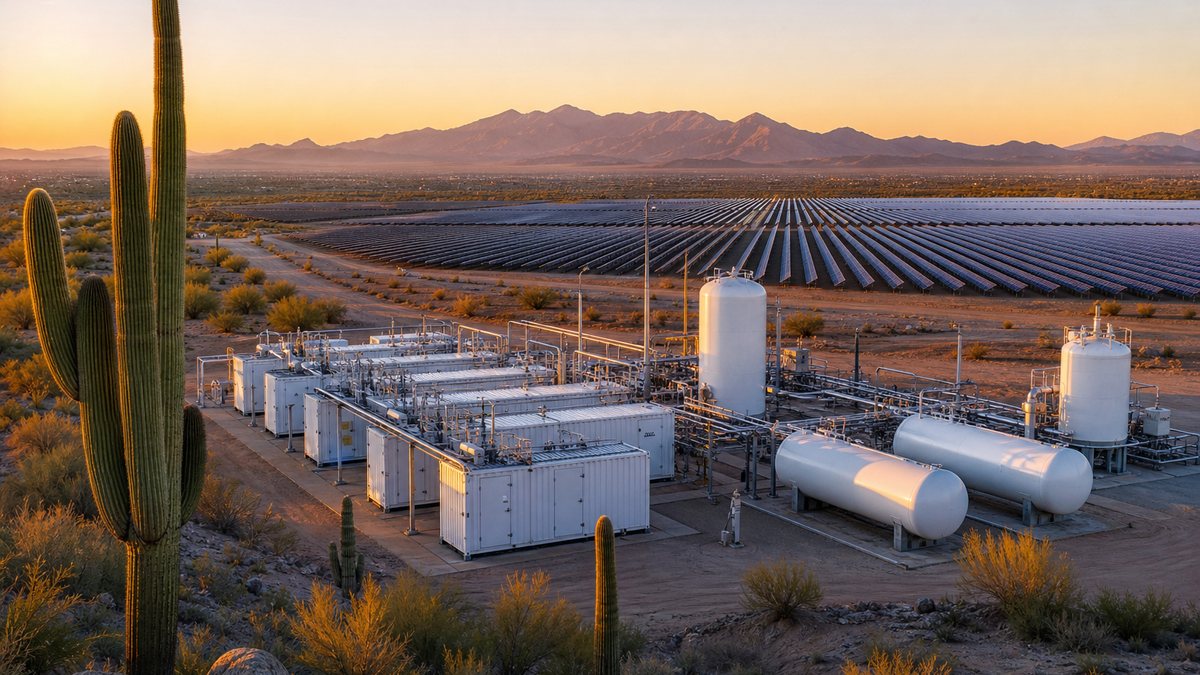
Green hydrogen in Nevada and Arizona is mostly a story of plans that stalled. The biggest Arizona project, Fortescue's $550 million, 80 MW plant in Buckeye, was cancelled in July 2025. The Arizona-Nevada hub bid was not selected for federal funding. What runs today is smaller: a liquid hydrogen plant in North Las Vegas, hydrogen buses in Reno and Las Vegas, and utility pilots.
- Biggest cancellation: Fortescue's Arizona Hydrogen project in Buckeye ($550 million, 80 MW electrolysis, more than 11,000 tons of liquid hydrogen a year) was dropped on a July 24, 2025 investor call, after site work began in May 2024.
- Biggest working plant: Air Liquide's $250 million liquid hydrogen facility in North Las Vegas opened May 24, 2022, with about 30 tonnes per day of capacity, mainly aimed at California's fuel-cell vehicle market.
- Federal hub: the Arizona-Nevada-Navajo Nation "SHINe" coalition (40+ organizations) was not selected as one of DOE's regional hydrogen hubs.
- Tax credit clock: the 45V clean hydrogen credit (up to about $3 per kg) now requires projects to begin construction before January 1, 2028, under the 2025 budget law, instead of 2033.
- Where hydrogen is used locally: fuel-cell buses at RTC Washoe (Reno) and RTC Southern Nevada (Las Vegas), and Southwest Gas hydrogen-blending tests with UNLV and ASU.
Hydrogen has a special place at SHYNE. The company's name stands for Sustainable Hydrogen Networks, and it was founded in Nevada in 2016 by Dr. Hervé Mazzocco, whose consulting work has included clean hydrogen alongside solar, storage and microgrids. So this is a topic we want to get right, which means separating the press releases from what is actually built, running and paying its way in the desert Southwest.
The honest summary in late 2026: the region has real hydrogen assets, but the wave of large "green" projects announced in 2021 to 2024 has mostly broken. The reasons are a mix of economics, federal policy changes and the simple fact that batteries got cheaper faster than electrolyzers did. Yet the underlying advantages of Nevada and Arizona have not gone away, and the next 14 months, before the 45V construction deadline, will decide whether any big project gets built here this decade.
What is green hydrogen, and what is a "hydrogen network"?
Hydrogen is a fuel and an industrial chemical that produces no carbon dioxide when used. The catch is how it is made. Almost all hydrogen in the U.S. today is made from natural gas, which releases carbon dioxide. A September 2, 2026 analysis by Clean Energy Group put it bluntly: "Over 90 percent of hydrogen projects in the US are tied to fossil fuels."
Green hydrogen is made by splitting water with electricity from renewable sources in a machine called an electrolyzer. That is why the desert Southwest looked so attractive: solar power in Nevada and Arizona is among the cheapest electricity anywhere in the country, and electricity is the largest cost of making green hydrogen.
But making hydrogen is only one link in the chain. A working hydrogen network needs every link at once:
- Production: electrolyzers powered by solar, wind, nuclear or the grid, or gas-based plants with or without carbon capture.
- Conditioning: hydrogen is very light, so it must be compressed or chilled to about minus 253°C to become liquid before it can be moved in useful quantities. Liquefaction is energy-hungry and expensive.
- Transport: tube trailers, liquid tankers, dedicated pipelines, or blending small amounts into existing natural gas pipes.
- Storage: tanks, or at very large scale, underground salt caverns.
- Demand: fueling stations for trucks and buses, industrial users, or power plants that burn hydrogen.
If any link is missing, the others lose money. That is exactly what happened in the Southwest: production projects were planned for trucks that never arrived, fueling stations were planned for trucks whose maker went bankrupt, and federal money meant to build all the links together went to other regions.
What happened to Fortescue's Arizona hydrogen plant?
Australian mining company Fortescue, through its energy arm, planned what was described as its first U.S. green hydrogen hub on a 158-acre site in Buckeye, west of State Route 85 in Maricopa County. According to ABC15 and the Phoenix Business Journal, the $550 million project combined an 80 MW electrolyzer with a liquefaction plant to produce more than 11,000 tons of liquid hydrogen a year, aimed at heavy-duty trucking. POWER magazine reported the groundbreaking on May 3, 2024, after Fortescue had made a final investment decision in 2023. Production had been expected in 2026.
It never got there. On a July 24, 2025 investor call, Fortescue said it would not proceed with the Arizona project or with its 50 MW PEM50 project in Gladstone, Australia. CEO Gus Pichot said "a shift in policy priorities away from green energy has changed the situation in the U.S." RBN Energy reported the two cancellations were expected to bring a write-down of about $150 million and that both sites could be repurposed. Hydrogen Insight classified both as "cancelled post-FID," meaning the company had already formally approved the spending.
The warning signs were visible at the groundbreaking itself. Even in May 2024, Fortescue's founder Andrew Forrest told POWER that the draft 45V rules, which required hourly matching of clean power, were "a straitjacket on the industry" and that Fortescue would likely reduce U.S. investment if the structure did not change.
| Project | Location | Size | Status (Nov. 2026) |
|---|---|---|---|
| Fortescue Arizona Hydrogen | Buckeye, AZ | 80 MW electrolysis; 11,000+ t/yr liquid H2; $550M | Cancelled July 2025 after site work began |
| Air Liquide liquid hydrogen plant | North Las Vegas, NV | ~30 tonnes/day liquid H2; $250M | Operating since May 2022 (company figures) |
| Palo Verde hydrogen demo (PNW Hydrogen) | Tonopah, AZ | $20M DOE award; 6 tonnes stored H2 → ~200 MWh | Funded 2021; no public update found |
| SHINe regional hub bid | AZ, NV, Navajo Nation | 40+ organizations | Not selected by DOE |
| Southwest Gas blending pilots | Las Vegas & Tempe | 5–50% blends (UNLV); up to 20% (ASU) | Pilots announced to start Q1 2022 |
Fortescue's exit is not proof that green hydrogen cannot work in Arizona. It is proof that a single large plant cannot work on its own when the trucks, stations and policy it depends on all shift at once. The project bet on one customer group, heavy-duty fuel-cell trucks, at the exact moment that market collapsed. Any future Southwest project will need several kinds of buyers lined up before it breaks ground.
What hydrogen is actually being produced in Nevada?
The most important working hydrogen asset in the region is Air Liquide's liquid hydrogen plant in North Las Vegas. Chemical Engineering reported its inauguration on May 24, 2022, as a $250 million investment with capacity of 30 tonnes of liquid hydrogen per day, Air Liquide's largest liquid hydrogen production and logistics facility. Air Liquide said it would run on renewable electricity and could also use renewable natural gas to meet California's Low Carbon Fuel Standard, and that its output was enough for more than 40,000 fuel cell vehicles in California. The company projected 25 full-time jobs at full capacity.
Those are company claims, and two details matter. First, the plant was built mainly to serve California, where most of the country's hydrogen cars and stations are. Second, local buyers have not found it cheap: as The Nevada Independent reported in December 2023, RTC Southern Nevada said buying hydrogen from the Air Liquide plant did not pencil out, while RTC Washoe was trucking weekly hydrogen deliveries from Sacramento.
In other words, Nevada makes liquid hydrogen at scale, but most of it leaves the state. That is a classic network problem: production sits next to a freeway to Los Angeles, not next to a local fleet big enough to use it.
Who uses hydrogen in Nevada and Arizona today?
Transit buses in Reno and Las Vegas
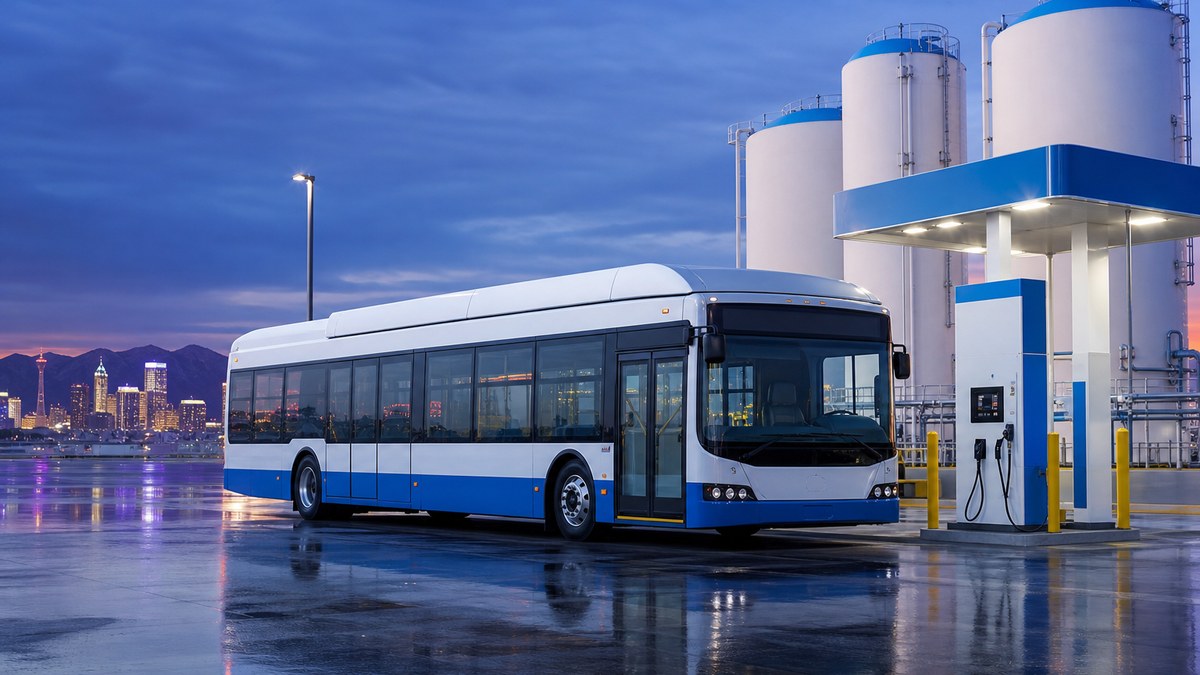
The clearest local demand comes from public transit. According to The Nevada Independent (December 26, 2023), RTC Southern Nevada added two hydrogen fuel cell electric buses in 2023, described as the first of their kind in the state, and planned to add 22 more in 2024. The agency had been awarded more than $16 million in federal funding for hydrogen buses and fueling infrastructure. Its fleet of about 400 buses was then roughly 80% "clean," mostly natural gas, with under 2% zero-emission.
In Reno, RTC Washoe received a $6.8 million federal grant in 2021 for two buses and a fueling station, and $8.8 million more in 2023 for six buses and an expanded station. The agency said hydrogen buses get about 300 miles per tank and refuel in no more than 10 minutes, which is why some transit managers prefer them to battery buses on long routes. "We think hydrogen is our path forward," RTC Washoe's Jim Gee told the paper. RTC Southern Nevada's Roger Johnson was more cautious: "It will be a bit of a slow transition."
We could not find a 2026 public update confirming exactly how many hydrogen buses are now in service in each fleet, so readers should treat the 2024 targets as plans, not confirmed deliveries.
Gas pipelines: blending tests
Southwest Gas, the Las Vegas-based utility that serves both states, announced hydrogen-blending pilots with UNLV and Arizona State University, expected to start in the first quarter of 2022 at its emergency response training facilities in Las Vegas and Tempe. According to the company, UNLV would use its own electrolyzer to make green hydrogen and blend it at 5%, 10% and 50%, while ASU would test blends of up to 20% hydrogen. CEO John Hester said at the time that the utility was "taking a proactive pioneering approach to hydrogen." Blending is a low-cost way to start using hydrogen, but it only cuts emissions modestly, because hydrogen carries about a third of the energy of natural gas by volume.
Nuclear hydrogen at Palo Verde
In October 2021, the U.S. Department of Energy awarded $20 million to a demonstration led by PNW Hydrogen, a unit of APS parent Pinnacle West, to make hydrogen with power from the Palo Verde Generating Station, the country's largest nuclear plant, about 50 miles west of Phoenix. POWER magazine reported that DOE said the project would use 6 tonnes of stored hydrogen to produce about 200 MWh of electricity at times of high demand. Planned phases ran through 2023. We found no recent public update on results, which is worth asking APS about.
Why did the Southwest hydrogen hub lose?
In November 2022, more than 40 organizations, led from Arizona State University's AzCaNE center, formed the Southwest Clean Hydrogen Innovation Network, or SHINe, covering Arizona, Nevada and the Navajo Nation. Members included APS, Salt River Project, Tucson Electric Power, Southwest Gas, NextEra, Linde and Air Liquide, according to the Arizona Technology Council and Power Engineering. They sought a share of the federal hydrogen hub program, funded at up to $7 billion by the 2021 infrastructure law.
The bid was not selected. DOE chose seven hubs elsewhere, including California's ARCHES and a Pacific Northwest hub. And those winners have since been hit too: Canary Media reported on October 10, 2025 that DOE rescinded $2.2 billion in awards to the California and Pacific Northwest hubs, part of a broader list of 321 cancelled grants. ARCHES said it would continue without federal financing.
For Nevada and Arizona this cuts both ways. The region missed the federal money, but it also avoided building plans around grants that later disappeared. And the loss of California's federal hub funding matters directly to Nevada, because California remains the main market for hydrogen made in North Las Vegas.
The Southwest's strongest hydrogen argument was never just sunshine. It was the combination of cheap solar, open land, interstate freight corridors and a big neighboring market in California. That argument still stands. What the region lacks is an anchor customer that is local, steady and large: a mine, a chemical plant, a fleet or a power plant that commits to buying hydrogen for years. Without one, every project is a bet on someone else's demand.
What happened to hydrogen trucks in Arizona?
Arizona was home to the most famous hydrogen truck maker in the country. Nikola had its headquarters in Phoenix and its factory in Coolidge, Pinal County, where, according to Transport Topics, it began producing hydrogen fuel cell versions of its Tre truck in July 2023. Its HYLA fueling unit had targeted 14 stations by the end of 2024 and 60 long term.
Nikola filed for Chapter 11 bankruptcy on February 19, 2025. In April 2025, Lucid Group bought the Phoenix headquarters and the 691,000-square-foot Coolidge plant for $30 million, according to court documents cited by Transport Topics, and planned to offer jobs to more than 300 former Nikola employees. In August 2025, Austin-based Hyroad Energy won the auction for 113 hydrogen fuel cell semis plus parts, software and intellectual property. By an update published September 28, 2026, Hyroad said it had reconnected 52 former Nikola trucks to its software, but its fueling plans focus on Los Angeles and Houston. "We've been focused on Texas and California as our primary markets from the beginning," CTO Aaron Lapsley said. The HYLA station network "has not materialized," the trade publication noted.
So the Coolidge plant now serves battery-electric car production rather than hydrogen trucks, and no major hydrogen truck fueling network is being built in Arizona or Nevada. That is the demand that projects like Fortescue's were counting on.
How does the 45V tax credit change the math?
The clean hydrogen production credit, Section 45V, pays producers per kilogram based on lifecycle emissions. According to the Congressional Research Service (updated March 30, 2026), the 2025 values for projects meeting wage and apprenticeship rules are:
| Lifecycle emissions (kg CO2e per kg H2) | 2025 credit per kg |
|---|---|
| Under 0.45 | $3.185 |
| 0.45 to under 1.5 | $1.065 |
| 1.5 to under 2.5 | $0.795 |
| 2.5 to 4.0 | $0.635 |
The 2025 budget law (P.L. 119-21, known as the One Big Beautiful Bill Act) kept the credit but moved the start-of-construction deadline from 2033 to January 1, 2028. Credits still run for 10 years once a plant is in service. The change shows up in the federal budget: CRS notes the Joint Committee on Taxation projected about $400 million of revenue loss for fiscal 2025 to 2029 in December 2025, compared with a 2024 estimate of $7.2 billion for fiscal 2024 to 2028. That drop reflects how few projects are now expected to claim it.
For a solar-powered electrolyzer in Nevada or Arizona, the top tier is the one that matters, because green hydrogen made with clean electricity can qualify for the full amount. But a developer that has not started construction by the end of 2027 loses the credit entirely. That gives Southwest developers roughly 14 months to move from plan to physical work.
Is there still money for hydrogen in 2026?
Less than before, but some. Clean Energy Group estimated about $400 million was invested across the U.S. hydrogen industry in January to March 2026, a small figure next to the multibillion-dollar announcements of 2022 and 2023. In Arizona, the Valley of the Sun Clean Cities Coalition reported on October 9, 2026 that DOE's Alternative Fuels and Feedstocks Office issued a notice of intent for up to $60 million in funding covering topics including hydrogen and natural gas blending, with the full funding notice expected in November 2026. That is a modest pot, but blending research is exactly where Southwest Gas and the region's universities already have test facilities.
The industry is also gathering in Nevada this month: the same newsletter notes that RE+ 26 runs November 16 to 19, 2026 in Las Vegas, combined with the GTSE transportation event. Expect hydrogen to be a smaller part of the floor than batteries, which is itself a sign of where the money has moved.
Where could green hydrogen still make sense in the desert?
Even skeptics of hydrogen for cars and light trucks see roles where batteries struggle. In Nevada and Arizona, the most realistic ones are:
- Long-duration and seasonal storage. Batteries handle the daily solar swing well. Storing summer solar for winter, or for multi-day events, is harder. The Palo Verde demonstration was designed to test exactly this idea: making hydrogen when power is cheap and burning it when demand peaks.
- Industry and mining. Nevada's growing lithium and battery-materials sector, including the Thacker Pass project and battery recycling near Reno, uses chemicals and heat. Some of that could eventually be supplied with clean hydrogen or hydrogen-derived chemicals.
- Backup power. Fuel cells already provide backup power in some data centers and telecom sites. With AI data centers driving huge new demand in both states, clean backup that avoids diesel is a possible niche.
- Transit and heavy fleets where routes are long and refueling time matters, as RTC Washoe has argued.
- Gas network decarbonization through blending, as Southwest Gas has tested, though the emissions benefit is limited.
What has not worked, so far, is building a giant production plant first and hoping the network follows. The successful version is likely to be smaller, built close to a committed user, and sized to grow.
The phrase "hydrogen network" is the right one. Microgrids in remote sites taught the industry that generation, storage and load must be designed together, not bolted on later. Hydrogen is the same, only harder: it needs production, conditioning, transport, storage and a buyer, all at once. The Southwest projects that survive will be the ones that look like small, complete networks around a real customer, not stand-alone factories.
What should Nevada and Arizona watch next?
- The 45V deadline (January 1, 2028). Watch for any Southwest developer announcing construction starts in 2027 to lock in the credit.
- Treasury and IRS rules. How "beginning of construction" is defined will decide whether paper projects can qualify.
- DOE's blending funding notice, expected this month, and whether Arizona or Nevada universities and utilities apply.
- Transit fleet updates from RTC Southern Nevada and RTC Washoe on how many fuel-cell buses are in service and what hydrogen costs per kilogram.
- The Buckeye site. Fortescue said its cancelled sites could be repurposed. Any new use for the 158 acres in Buckeye would be a telling signal.
- California demand. The North Las Vegas plant depends on California's hydrogen vehicle market and fuel standards; changes there flow straight back to Nevada.
- Data-center backup power requests in NV Energy, APS and SRP filings, which could create a new, local buyer for fuel cells.
Working on hydrogen, storage or clean fuels in Nevada or Arizona?
SHYNE covers the energy and technology projects reshaping the desert Southwest. Send us your project, data or story tip.
Email hgm@shyneltd.comFrequently asked questions
Is there a green hydrogen plant in Arizona?
Not at commercial scale. The largest planned one, Fortescue's $550 million, 80 MW project in Buckeye, was cancelled in July 2025 after site work had started. Arizona activity today is mostly research and pilots, such as the DOE-funded Palo Verde nuclear hydrogen demonstration and ASU blending tests with Southwest Gas.
Why did Fortescue cancel its Buckeye hydrogen project?
Fortescue said on a July 24, 2025 investor call that a shift in U.S. policy priorities away from green energy had changed the situation. The company had earlier criticized the strict draft rules for the 45V tax credit, and the hydrogen truck market it planned to serve collapsed.
Does Nevada produce hydrogen?
Yes. Air Liquide's liquid hydrogen plant in North Las Vegas opened in May 2022 with about 30 tonnes per day of capacity, according to the company. Much of its output serves fuel-cell vehicles in California rather than Nevada users.
Are there hydrogen buses in Las Vegas and Reno?
Yes. RTC Southern Nevada added two hydrogen fuel cell buses in 2023 and planned more, and RTC Washoe in Reno received federal grants in 2021 and 2023 for eight hydrogen buses and a fueling station. Current fleet counts have not been publicly updated in 2026.
What is the 45V hydrogen tax credit deadline?
Under the 2025 federal budget law, clean hydrogen projects must begin construction before January 1, 2028 to qualify for the 45V credit, instead of 2033. The credit is worth up to about $3 per kilogram for the cleanest hydrogen and lasts 10 years once a plant is running.
Did Arizona and Nevada get a federal hydrogen hub?
No. The Southwest Clean Hydrogen Innovation Network, a coalition of more than 40 organizations from Arizona, Nevada and the Navajo Nation, applied but was not selected. In October 2025 DOE also rescinded $2.2 billion from the California and Pacific Northwest hubs that had won.
What happened to Nikola's hydrogen trucks in Arizona?
Nikola filed for bankruptcy in February 2025. Lucid bought its Phoenix headquarters and Coolidge factory for $30 million, and Hyroad Energy bought its hydrogen trucks and intellectual property, focusing on Texas and California rather than Arizona.
Can hydrogen be blended into natural gas pipelines?
In small amounts, yes. Southwest Gas has tested blends with UNLV and ASU, including 5 to 50 percent at its Las Vegas training facility and up to 20 percent in Tempe. Blending reduces emissions only modestly because hydrogen carries less energy per volume than natural gas.
What does SHYNE stand for?
SHYNE stands for Sustainable Hydrogen Networks. The company was founded in Nevada in 2016 by Dr. Hervé Mazzocco and now publishes technology and energy news for Nevada and Arizona.
Keep reading
Sources
- ABC15 / Phoenix Business Journal, Fortescue cancels $550 million hydrogen hub project in Buckeye (Aug. 4, 2025).
- Hydrogen Insight, Fortescue abandons two green hydrogen projects which had both passed a final investment decision (July 24, 2025).
- RBN Energy, Fortescue pulls the plug on Arizona hydrogen project (2025).
- POWER, Major hydrogen project breaks ground in Arizona, while dispute over tax credit looms (May 6, 2024).
- Chemical Engineering, Air Liquide inaugurates $250-million hydrogen plant near Las Vegas (May 24, 2022).
- The Nevada Independent, Overshadowed by electrification push, hydrogen gains steam in Nevada public transportation (Dec. 26, 2023).
- Congressional Research Service, The Section 45V clean hydrogen production credit (IF12602) (updated March 30, 2026).
- Canary Media, DOE cuts to regional hydrogen hubs (Oct. 10, 2025).
- Clean Energy Group, Hydrogen in 2026: a fossil fuel reality check (Sept. 2, 2026).
- Transport Topics, Lucid to take over Nikola's Arizona electric truck plant, HQ (April 11, 2025).
- Trucks, Parts and Service, After Nikola's fall, Hyroad Energy rises in hydrogen trucking (Feb. 10, 2026, updated Sept. 28, 2026).
- POWER, Power-to-power hydrogen demonstration involving largest U.S. nuclear plant gets federal funding (Oct. 14, 2021).
- Southwest Gas, Southwest Gas announces hydrogen-blending pilot programs with Arizona and Nevada universities.
- Arizona Technology Council, Regional clean hydrogen hub develops in the Desert Southwest (Dec. 2022); Power Engineering, Energy leaders in Arizona, Nevada propose Southwest clean hydrogen hub (Nov. 28, 2022).
- Valley of the Sun Clean Cities Coalition, October 2026 newsletter (Oct. 9, 2026).
SHYNE reports on technology and energy for general information. Project figures and timelines are as stated by the companies and sources listed and may change. Nothing here is investment advice.