Redwood Materials in Nevada: from battery recycling to powering AI data centers
The Tesla co-founder's battery recycler near Reno is now one of the biggest second-life energy storage players in America. Here is what Redwood actually does in Northern Nevada, what is confirmed, what is still a company claim, and why it matters for Nevada and Arizona.
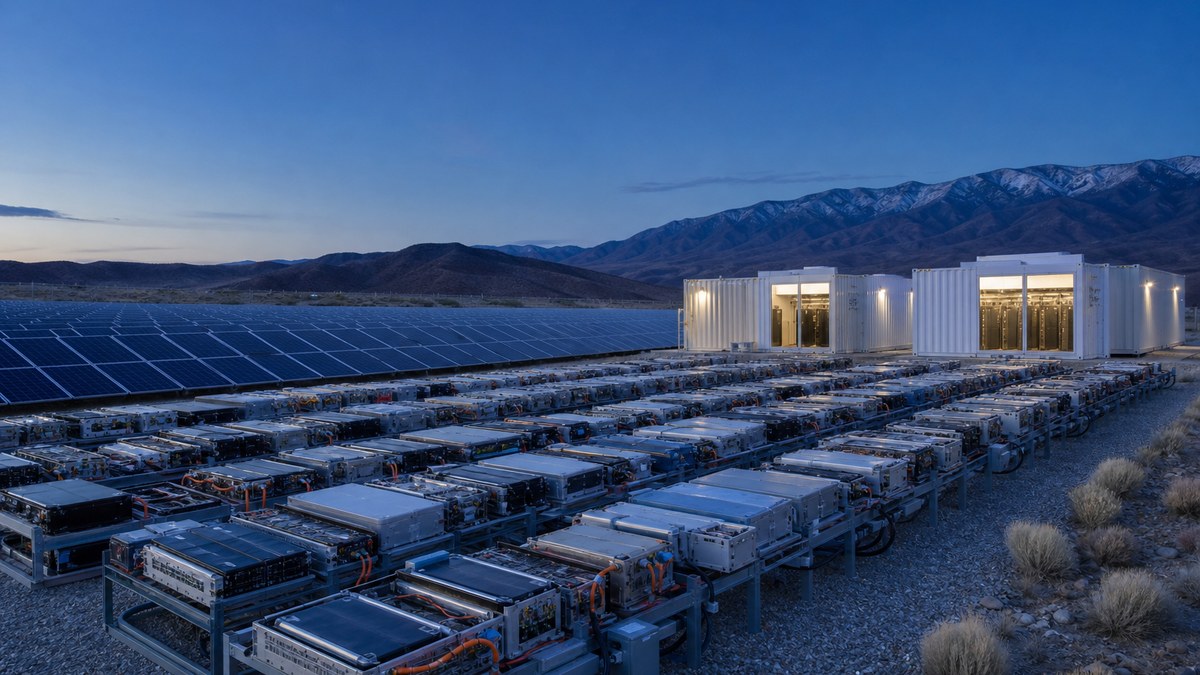
Redwood Materials, founded in 2017 by former Tesla CTO JB Straubel and headquartered in Carson City, recycles lithium-ion batteries at a large campus in McCarran, east of Reno. Since June 2025 it has also reused old EV packs as energy storage: a 12 MW / 63 MWh solar-plus-battery microgrid on its Nevada campus powers Crusoe AI data centers, and that site is expanding to 20 MW.
- Who: Redwood Materials, founded 2017 by JB Straubel; headquarters in Carson City; main plant at 1201 Battery Boulevard, McCarran (Storey County), in the Tahoe-Reno Industrial Center.
- Recycling scale (company figures): more than 20 GWh of batteries a year, about 250,000 EVs' worth, and over 60,000 metric tons of materials produced in Nevada in 2024.
- Energy storage: Redwood Energy launched June 26, 2025 with a 12 MW / 63 MWh microgrid built from roughly 800 used EV packs; in March 2026 Crusoe said it would add 20 more modular data centers there, taking the site to 20 MW.
- Money: a $425 million Series E closed in January 2026 (Google, Nvidia's NVentures, Eclipse and others); TechCrunch reported a valuation above $6 billion.
- Restructuring: about 135 jobs (roughly 10%) cut on April 21, 2026, after a 5% cut in November 2025, to focus on energy storage.
- Latest Nevada filing: an application to revise its state air permit, covering 444 units and a new wet-shredding process, logged by Nevada regulators on October 15, 2026.
For most of its life, Redwood Materials was a recycling story. A Tesla co-founder set up shop in the Nevada desert to take apart old laptop batteries, phone batteries and, eventually, entire electric-vehicle packs, recover the nickel, cobalt, lithium and copper inside, and sell those materials back into the battery supply chain. That story is still true. But over the past 16 months the company has bolted a second business onto it, and that second business is now what gets the headlines: using batteries that are too worn for a car but far from dead to power AI computing.
That shift lands squarely in the middle of the two biggest energy fights in the Southwest right now. In Nevada, utilities and regulators are trying to work out how to serve a flood of data-center requests without loading the cost onto households. In Arizona, the state has become the fastest-growing battery storage market in the country. Redwood sits at the junction of both trends, so it is worth understanding exactly what it does, how big it really is, and where the company's own claims outrun the independent evidence.
What does Redwood Materials do in Nevada?
Redwood runs three kinds of operations in Northern Nevada, according to company materials and local reporting:
- Headquarters in Carson City. The company's head office is on Lockheed Way in Carson City, where its first plant opened in 2019, according to the SC Daily Gazette.
- Battery Materials Campus 1 in McCarran. The main industrial site, at 1201 Battery Boulevard in the Tahoe-Reno Industrial Center (TRIC) in Storey County, is the same industrial park that hosts Tesla's Gigafactory Nevada. Northern Nevada Business Weekly reported that the campus covers about 300 acres, with roughly 1 million square feet already under roof at the time and more than 5 million square feet planned at full buildout.
- An energy campus. On the same Sparks/McCarran property, Redwood operates the solar-plus-storage microgrid that powers Crusoe's modular data centers. Canary Media described a two-acre field of used EV packs and a 32-acre open-air depot where incoming battery deliveries are sorted.
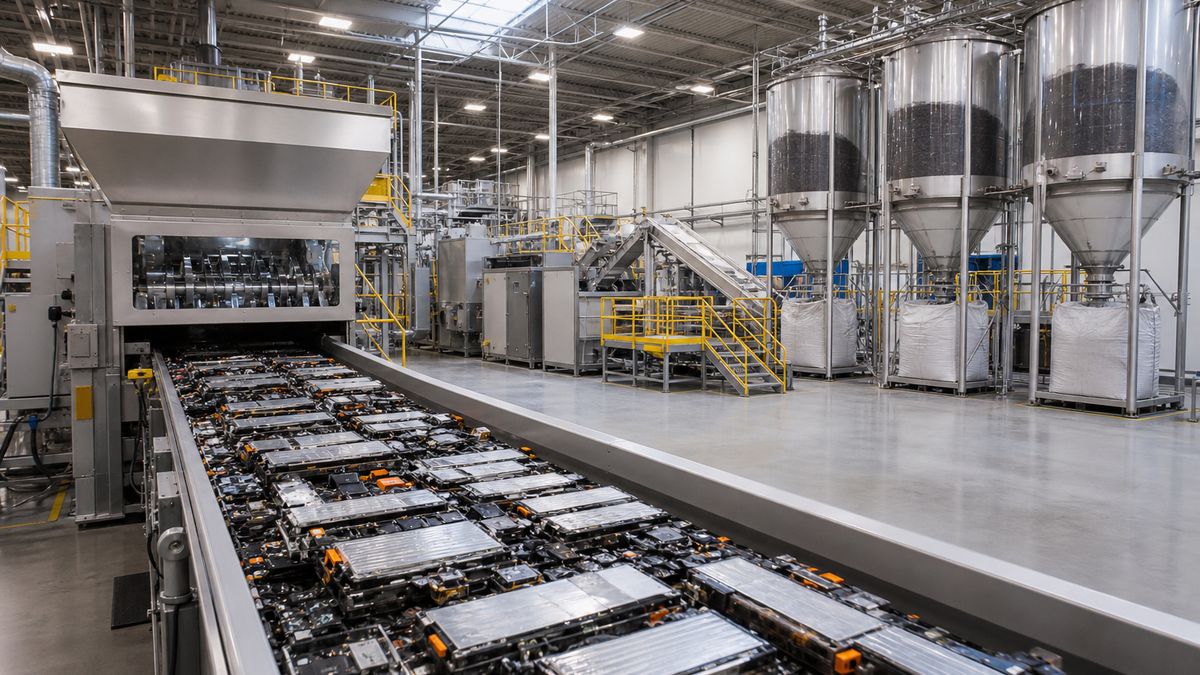
At the plant, batteries and factory scrap arrive from across North America. Redwood says it recovers more than 95% of key metals and turns them into products it sells: copper foil for battery anodes and cathode active material. E&E News reported that Redwood's Nevada copper foil was being shipped to Panasonic's cell plant inside the nearby Gigafactory, a short-haul loop that Nevada's economic development officials have pitched as the state's "lithium loop."
Redwood in numbers
| Metric | Figure | Source and status |
|---|---|---|
| Founded | 2017, by JB Straubel | Confirmed (multiple outlets) |
| Batteries processed | 20+ GWh a year (~250,000 EVs) | Company figure, reported by TechCrunch (June 2025) |
| Share of North American recycling | "More than 70%" of used packs; elsewhere "90%" | Company claims; figures differ by source |
| Materials produced in Nevada, 2024 | 60,000+ metric tons | Company figure, reported by SC Daily Gazette (Nov. 2025) |
| Revenue, 2024 | About $200 million | Reported by TechCrunch (June 2025) |
| Total private capital raised | About $2.3 billion | TechCrunch (Jan. 2026) |
| Valuation | Above $6 billion | Source cited by TechCrunch (Jan. 2026); not disclosed by Redwood |
| Storage target | 20 GWh deployed by 2028 | Company goal, reported by TechCrunch |
What is Redwood Energy, and how does it power AI data centers?
Redwood Energy is the company's storage business, launched on June 26, 2025. The idea is simple: many EV battery packs that come off the road still hold most of their capacity. Instead of shredding them immediately, Redwood tests them, sorts out the risky ones, and wires the good ones into large stationary batteries. When they finally do wear out, they go back into Redwood's own recycling line next door.
The hard part is that EV packs are not standard. Redwood says there are more than 100 different electric car models in the U.S., each with its own pack design, voltage and chemistry. Its answer is in-house power electronics, which it calls a Pack Manager, that sit between each used pack and the system and run every pack according to its own needs. Canary Media reported that this design also avoids heavy metal enclosures and needs almost no poured concrete, which Redwood says saves time and money.
The first project: Crusoe's off-grid AI campus
The launch project, built with AI infrastructure company Crusoe, sits on Redwood's campus east of Reno. According to TechCrunch and Data Center Knowledge, it combines an adjacent solar array (built with Erthos) with roughly 800 retired EV packs (TechCrunch reported 805; Canary Media counted 792) to deliver 12 MW of power and 63 MWh of storage. That was enough to run a Crusoe modular data center with about 2,000 GPUs. Crusoe's CEO said the project came together in about four months, and Redwood described it as the largest microgrid in North America and likely the largest second-life battery deployment anywhere.
On March 24–25, 2026, the companies announced the next step. ESS News reported that Crusoe would add 20 more Crusoe Spark modular data centers to the four already on site, for 24 in total, raising the site's power demand to 20 MW. Redwood reported 99.2% operational availability since June 2025. The microgrid runs off-grid, with the local utility grid used only as a backup for Crusoe's cloud service.
Other storage deals
- Rivian (April 14, 2026): a 10 MWh second-life storage system at Rivian's factory in Normal, Illinois, using packs from Rivian vehicles. Redwood calls it the first system of its kind at a U.S. automaker's plant.
- General Motors (July 2025 and June 2026): a deal to pursue U.S.-built GM batteries for storage, extended in June 2026 to a partnership across the full battery lifecycle.
- Safety: on March 25, 2026, Redwood said its storage systems met a new industry safety benchmark. It did not publish the full test data in that post.
The Crusoe project is the most interesting thing to happen to second-life batteries in years, because it's real, it's big and it has run for more than a year. But it is still one site, on Redwood's own land, with a partner that also benefits from the publicity. The uptime and cost figures come from the companies. The proof that matters will be the first projects on someone else's land, financed by lenders who are not Redwood's investors, and running under a utility interconnection agreement in Nevada or Arizona.
Is second-life battery storage actually cheaper?
Redwood's chief commercial officer Cal Lankton, now the company's COO, told Bloomberg in June 2025 that reused batteries cost about half as much as new lithium-ion systems for the same performance. Founder JB Straubel has argued that reusing a pack can produce "almost an order of magnitude" more value than recycling it right away. Redwood has not published a dollar-per-kilowatt-hour figure, and its October 23, 2026 post on "delivering energy faster and cheaper" makes the cost case in words, not numbers.
There are good reasons to think the savings are real and good reasons to be cautious:
| For second-life storage | Against, or still unproven |
|---|---|
| Packs are already paid for; Redwood receives them through its recycling network | New battery prices, especially Chinese LFP cells, have fallen sharply, shrinking the gap |
| Speed: the first 63 MWh site was built in about four months | Mixed packs from many makers add control and safety complexity |
| No long wait for a grid connection when the system runs off-grid | Degraded cells mean shorter remaining life and more monitoring |
| Packs go straight back into Redwood's recycling line at end of life | Few large projects exist, so long-term performance data is thin |
Canary Media noted that second-life storage has rarely been deployed at scale, that most earlier projects were small and grant-funded, and that much of the performance evidence still comes from company executives. That is not a reason to dismiss it, only a reason to watch the next projects closely.
Why did Redwood cut jobs while raising $425 million?
On the surface, 2026 looks contradictory. In January Redwood closed a $425 million Series E with Google as a new investor, after a $350 million first close in October 2025 that included Nvidia's venture arm, NVentures. Then on April 21, 2026, Straubel told staff that about 135 employees, roughly 10% of the workforce, were being laid off, five months after a 5% cut in November 2025. TechCrunch reported that the cuts hit engineering and operations.
The explanation lies in the economics of recycling. Energy-Storage.News described U.S. battery recycling as "in the doldrums": cheap new batteries and components from China have pushed down the value of recovered metals, and the U.S. still lacks enough cathode makers to buy recycled material at a premium. Canary Media pointed to Li-Cycle's bankruptcy and Ascend Elements' delays at its Kentucky plant. Straubel said "parts of the company have expanded faster than needed to support the direction" of Redwood, that its materials business was nearing profitability, and that the company could deliver its critical projects "with a smaller team that is more focused."
Redwood also gave up federal money. It received a conditional $2 billion Department of Energy loan commitment in February 2023 to expand its McCarran campus, but the SC Daily Gazette reported that Redwood withdrew from the loan in fall 2024 in favor of private funding.
Redwood's pivot is a sign of where the money is. Recycling metals is a commodity business that lives and dies on nickel and lithium prices. Firm power for data centers is a premium market where customers will pay for speed. For Northern Nevada, that is mostly good news: the energy business is being built on the same Storey County campus, and it keeps used batteries in the state instead of shipping them out. SHYNE's founder worked in grid-scale batteries at Imergy Power Systems, and the storage industry's history is consistent: companies win on bankable performance data, not demos, so Redwood's next 12 months of results matter more than any funding round.
What is happening at the McCarran campus now?
The most recent public paper trail is a permit filing. W4 News reported on October 15, 2026 that Redwood has applied to revise its Class II air-quality operating permit with the Nevada Division of Environmental Protection (NDEP) for Battery Materials Campus 1. The 234-page application, with a transmittal letter dated September 17, 2026, asks for 16 categories of changes, including:
- adding a wet-shredding process for batteries;
- moving 30 building heaters into the permitted-unit list while halving their annual fuel use;
- removing several systems from the permit;
- revising emissions and throughput limits for calcination, dust collection, material fabrication and a demonstration plant.
The filing covers 691 units in total, 444 of them affected. Facility-wide potential-to-emit estimates include about 78.8 tons a year of nitrogen oxides and about 19,174 tons a year of CO2-equivalent. These are permitting maximums, not measured emissions, and the application does not authorize anything on its own; the NDEP director will decide. As of the report, no public comment period had been scheduled.
Wet shredding is a common way to break batteries down safely in a liquid that suppresses fire and dust. Redwood has not publicly explained why it is adding the process now, so any link to higher volumes or the storage business is speculation for the moment.
How does Redwood fit into Nevada's battery economy?
Northern Nevada has spent a decade trying to become America's battery valley. The pieces, as of late 2026:
| Link in the chain | Nevada project | Status (sourced) |
|---|---|---|
| Lithium mining | Thacker Pass (Lithium Americas), Humboldt County | Under construction; WBUR reported in March 2026 it was set to open the following year |
| Lithium and boron mining | Rhyolite Ridge (Ioneer), Esmeralda County | Construction expected to start in 2026, per WBUR (March 2026) |
| Cells and packs | Tesla Gigafactory Nevada with Panasonic, TRIC | Operating; Tesla Semi volume production began in 2026 |
| Recycling and materials | Redwood Materials, McCarran; American Battery Technology Company, TRIC | Operating |
| Second-life storage | Redwood Energy / Crusoe, Redwood campus | Operating, expanding to 20 MW |
| Workforce and R&D | Nevada Tech Hub at the University of Nevada, Reno | Federally backed; training for the "lithium loop" |
The state has paid for some of this. E&E News reported that Nevada granted Redwood about $81 million in tax abatements. In return, the company projected around 1,500 to 1,600 jobs at full scale, a number that now looks further away after two rounds of layoffs. Redwood has not said how many of the cuts were in Nevada.
Redwood also connects directly to the data-center boom covered in our piece on AI data centers in Nevada and Arizona. NV Energy faces a queue of huge new loads, and several developers have proposed private gas plants to bypass the grid. Redwood and Crusoe are effectively running a small, clean version of the same idea: building power on site instead of waiting years for a utility connection.
What does this mean for Arizona?
Redwood does not operate a plant in Arizona, but the state is arguably the most important market for what Redwood Energy sells.
- The biggest storage growth in the country. KTAR reported on September 4, 2026, citing SEIA and Benchmark Mineral Intelligence, that Arizona added more than 6.2 GWh of new storage in the second quarter of 2026, the strongest single-state quarter on record, and overtook Texas for new capacity in the first half of the year with a 27% share of the national market.
- Data-center demand. Metro Phoenix is one of the largest data-center markets in the U.S., and Arizona utilities APS and SRP are racing to add capacity, as we covered in our data-center power explainer. Fast, off-grid power for AI campuses is exactly the pitch Redwood made in Nevada.
- Competition from new batteries. LG Energy Solution announced in 2024 a $5.5 billion battery complex in Queen Creek, including a 17 GWh plant for LFP energy-storage cells targeted for 2026. New, made-in-Arizona storage cells would compete directly with second-life packs on price. SHYNE could not independently confirm the plant's current production status.
- Used batteries to collect. Arizona's EV industry, from Lucid in Casa Grande to the region's large and growing EV fleet, will eventually produce a steady stream of retired packs. Nevada is the closest major recycling and reuse hub.
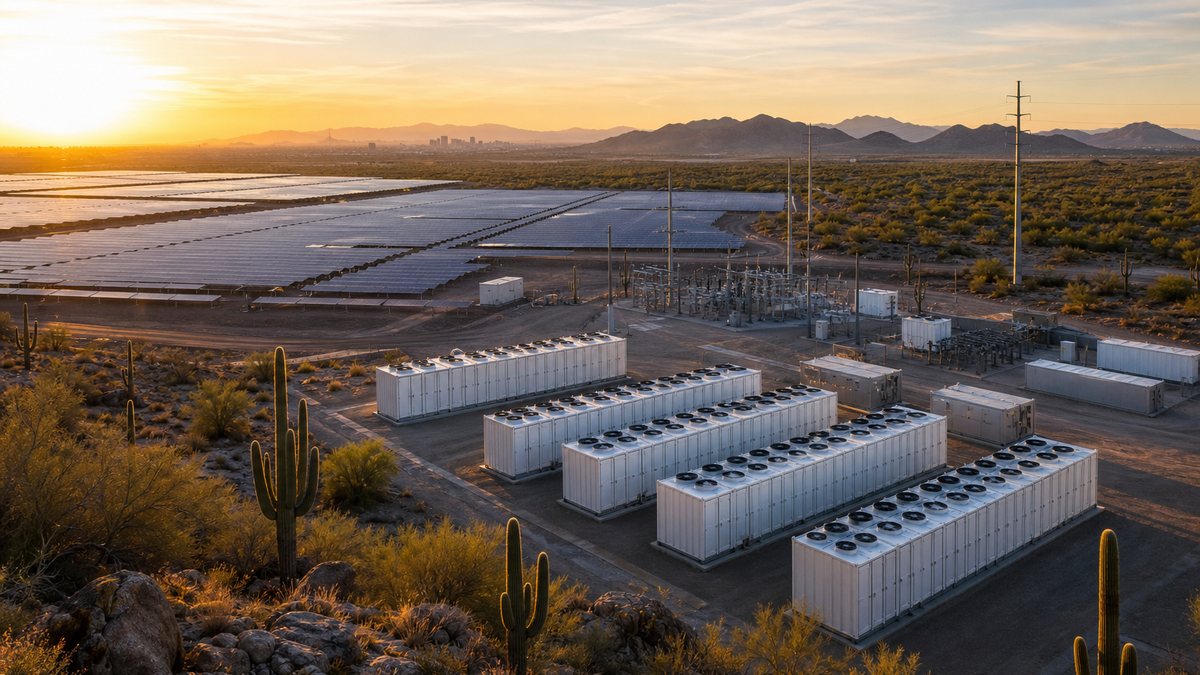
Arizona already pairs huge solar farms with batteries. The question for Redwood is whether utilities and data-center developers there will accept a mixed fleet of used packs, or whether they will stick with new, warrantied cells from suppliers like LG.
What should Nevada and Arizona watch next?
- The NDEP decision on Redwood's air permit revision and whether a draft permit or public comment period is posted.
- The Crusoe expansion to 20 MW and whether Redwood publishes independent performance data after its first full year of operation.
- A first third-party Redwood Energy project in Nevada or Arizona, especially one connected to NV Energy, APS or SRP.
- Progress toward 20 GWh by 2028. Redwood said it had more than 1 GWh of packs on hand in mid-2025, with about 4 GWh more expected. Deployed totals have not been published.
- Recycling economics. Lithium and nickel prices, and whether new U.S. cathode plants create buyers for recycled material.
- Jobs. Whether Redwood's Nevada headcount recovers toward the 1,500 it once projected.
Working on batteries, recycling or storage in Nevada or Arizona?
SHYNE covers the energy and technology projects reshaping the desert Southwest. Send us your story, project or announcement.
Email hgm@shyneltd.comFrequently asked questions
What is Redwood Materials?
Redwood Materials is a battery recycling and energy storage company founded in 2017 by former Tesla CTO JB Straubel. It is headquartered in Carson City, Nevada, and runs its main plant in McCarran, in the Tahoe-Reno Industrial Center east of Reno.
Where is Redwood Materials located in Nevada?
Its headquarters is in Carson City. Its main industrial site, Battery Materials Campus 1, is at 1201 Battery Boulevard in McCarran, Storey County, with a mailing address in Sparks. The Crusoe data-center microgrid is on the same campus.
How many batteries does Redwood recycle?
Redwood says it processes more than 20 GWh of batteries a year, roughly the equivalent of 250,000 electric vehicles, and produced more than 60,000 metric tons of materials in Nevada in 2024. These are company figures.
What is Redwood Energy?
Redwood Energy is the company's storage business, launched in June 2025. It repurposes used EV battery packs that still hold useful capacity into large stationary batteries, often paired with solar, for data centers and factories.
How big is the Redwood and Crusoe data center microgrid?
The first system is 12 MW and 63 MWh, built from roughly 800 retired EV packs plus an adjacent solar array. In March 2026 Crusoe said it would add 20 modular data centers to the four on site, raising demand to 20 MW.
Are second-life EV batteries safe for energy storage?
Redwood screens packs and says its systems met a new industry safety benchmark in March 2026. Independent long-term data is still limited because few large second-life projects exist, so performance and safety records are worth watching.
Did Redwood Materials have layoffs?
Yes. On April 21, 2026, Redwood laid off about 135 employees, roughly 10% of its workforce, after a 5% cut in November 2025. The company said it was restructuring to focus on energy storage.
Did Redwood get a federal loan?
Redwood received a conditional $2 billion Department of Energy loan commitment in February 2023 for its Nevada campus, but it withdrew from the loan in fall 2024 and relied on private funding instead.
Does Redwood operate in Arizona?
Redwood has no announced plant in Arizona. Its Nevada campus is the closest major recycling and reuse hub for the Southwest, and Arizona, the fastest-growing U.S. storage market in early 2026, is a natural market for its storage business.
Who invests in Redwood Materials?
Its 2025–2026 Series E of $425 million included Eclipse, Google, Nvidia's venture arm NVentures, Capricorn and Goldman Sachs. Earlier backers include Goldman Sachs, T. Rowe Price, Fidelity, Ford and Amazon's Climate Pledge Fund.
Keep reading
Sources
- TechCrunch, Redwood Materials launches energy storage business, and its first target is AI data centers (June 26, 2025).
- Canary Media, Redwood Materials built record grid storage project using old EV batteries (July 2, 2025).
- Data Center Knowledge, Crusoe, Redwood partner on data center powered by used batteries (June 2025, via Bloomberg).
- ESS News, Second-life EV batteries get tick from US data center operator (March 25, 2026).
- TechCrunch, Redwood attracts Google for its $425M Series E (Jan. 28, 2026).
- TechCrunch, Redwood Materials lays off 10% in restructuring to chase energy storage business (April 21, 2026).
- Energy-Storage.News, US battery recycling in doldrums: updates from Redwood Materials, Ascend Elements (2026).
- SC Daily Gazette, SC battery company begins recycling operations in the Lowcountry (Nov. 13, 2025).
- W4 News, Redwood Materials seeks air permit revision in Nevada (Oct. 15, 2026).
- Redwood Materials newsroom, How Redwood is delivering energy faster and cheaper (Oct. 23, 2026) and The Redwood Energy ecosystem (Oct. 14, 2026); news archive (company statements).
- Northern Nevada Business Weekly, Battery recycler eyes 5 million-square-foot space (Sept. 2023).
- E&E News, With Biden aid, Nevada dreams of a "lithium loop" (2023).
- WBUR via Connecticut Public, Home to the only lithium mine in the U.S., Nevada is ready for more (March 5, 2026).
- KTAR, Arizona leads nation in battery storage growth, overtaking Texas (Sept. 4, 2026).
- KED Global, LG's $5.5 billion LFP, ESS battery plants in Arizona to kick off in 2026 (April 4, 2024).
SHYNE reports on technology and energy for general information. Figures marked as company claims are as stated by Redwood Materials and its partners and have not been independently verified. Timelines may change. Nothing here is investment advice.