
Tesla Semi volume production in Nevada: what the new truck factory means for the Southwest
Seven years late, Tesla is now building its Class 8 electric truck at scale next to Gigafactory Nevada, on 4680 battery cells. Here is what is confirmed, what is still a company claim, and why it matters for freight, power and jobs in Nevada and Arizona.
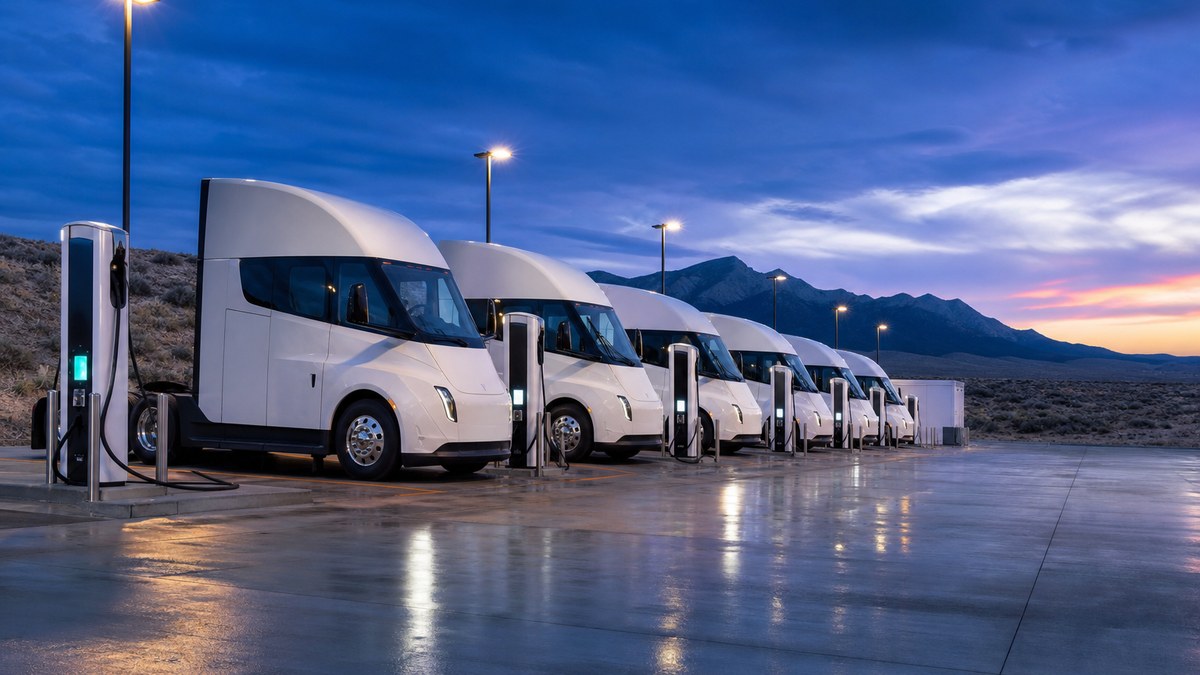
Tesla Semi volume production began at a dedicated truck factory beside Gigafactory Nevada in Storey County, with a launch event on September 24, 2026. Tesla says the 1.8 million-square-foot plant can eventually build 50,000 trucks a year, but its Q3 2026 report lists 25,000 of installed capacity and gives no production numbers. The trucks now use Tesla's own 4680 cells.
- Where: a new Semi factory on Tahoe-Reno Industrial Center land next to Gigafactory Nevada (Sparks mailing address), Storey County, Nevada.
- When: first truck off the high-volume line in April 2026; volume-production launch event for customers on the evening of September 24, 2026.
- Capacity: Tesla's Semi chief Dan Priestley gave 50,000 trucks a year (about 1,000 a week) as the plant's design capacity; Tesla's Q3 2026 update (October 21) lists 25,000 of installed annual capacity. Actual output has not been disclosed.
- Battery: production trucks switched from supplier 2170 cells to Tesla's in-house 4680 cells.
- Range (Tesla, February 2026): 325 miles Standard Range and 500 miles Long Range at 82,000 lb, rated at 1.7 kWh per mile.
- Orders: Tesla was picked on September 22, 2026 as primary supplier for a 2,500-truck order through the ZET SCALE shipper-carrier alliance; Einride placed a 500-truck order in August.
- Price: not officially published. Electrek reported a $290,000 customer quote for the Long Range in February 2026.
The Tesla Semi has been one of the longest-running promises in the electric vehicle industry. It was unveiled in November 2017, on the same night as the second-generation Roadster, with production promised for 2019. The date slipped to 2021, then 2022, then 2023. PepsiCo received the first hand-built trucks at its Modesto and Sacramento sites on December 1, 2022, but those came from a low-rate pilot line, not a real factory.
That changed in 2026, and it changed in Northern Nevada. Tesla built what it calls "our first factory built for Semi" beside its original Gigafactory east of Reno. The first truck rolled off the high-volume line in April, and on September 24 Tesla held an invite-only event where fleets including PepsiCo, DHL and US Foods took the keys. For a region that already makes batteries, recycles them and is trying to attract heavy industry, this is one of the most significant manufacturing milestones of the year.
It is also a story that needs careful reading. Several of the biggest numbers come from Tesla itself, a few of them conflict, and the company has not said how many trucks it has actually built. Below, we separate what is confirmed from what is claimed.
What exactly started in Nevada?
The new plant sits on Tahoe-Reno Industrial Center land in Storey County, next to Gigafactory Nevada, and carries a Sparks mailing address, according to The Weekly Driver's reporting on the launch. It is separate from another Tesla building permitted on Airway Drive in Reno. Electrek, which covered the September 24 event, reported the factory at 1.8 million square feet and said Standard Range, Long Range and a European-specification truck are all built on one assembly line.
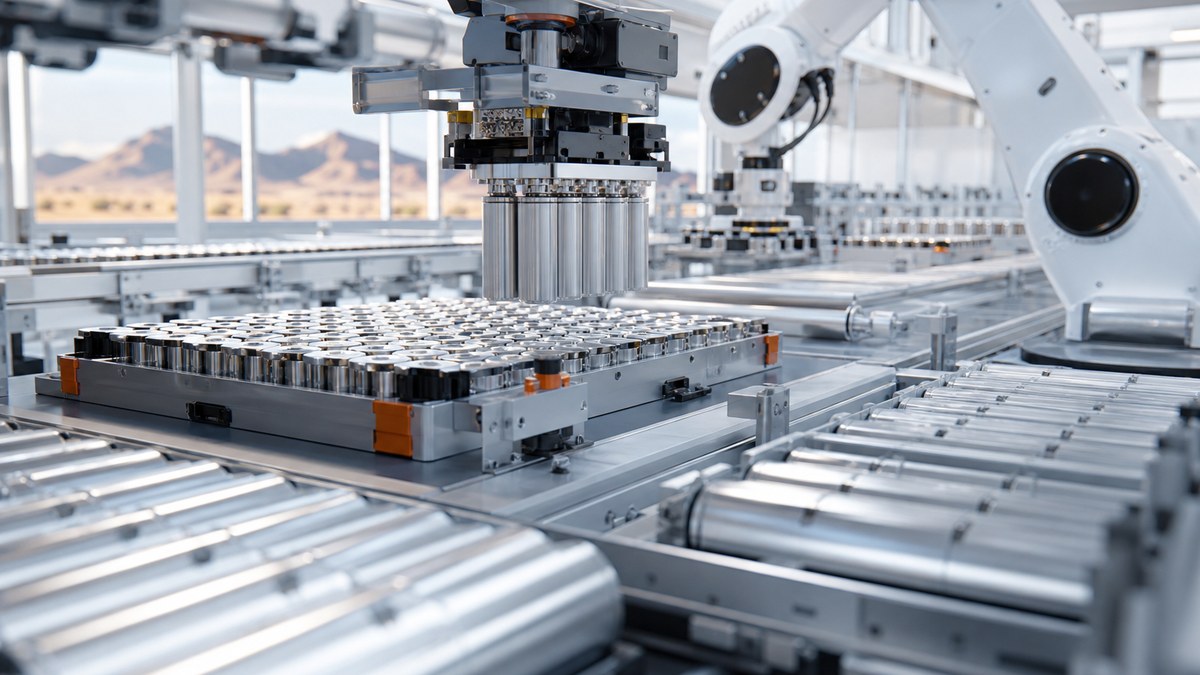
Tesla describes the plant as highly vertically integrated. According to the company, it makes stampings, battery packs, drive axles, high-voltage distribution, cooling modules and even seats in-house, and it says the factory has one of its most automated battery lines and applies the first powder-coated finish on a Class 8 truck. These are company statements; outside reporters were not given production data.
The timing matters. Electrek had already described the September event as largely ceremonial in an August report, because the high-volume line had been producing trucks since April. In other words, September 24 marked the public launch of volume production, while the line itself had been ramping for about five months.
The two capacity numbers
Readers will see two very different capacity figures, and both come from Tesla:
- 50,000 trucks a year. Given by Semi program lead Dan Priestley at the launch (about 1,000 a week). This is best read as the plant's design or target capacity.
- 25,000 trucks a year. Listed as installed annual capacity in Tesla's Q3 2026 results, released October 21, as reported by FreightWaves. Tesla did not say how many Semis it produced or delivered in the quarter.
Installed capacity is not the same as production. Tesla's capacity tables have historically shown what equipment is in place, not what the factory is actually turning out. Until Tesla reports Semi deliveries, nobody outside the company knows the real run rate.
| Item | Figure | Status | Source |
|---|---|---|---|
| Design capacity | 50,000 trucks/year | Company claim (target) | Tesla at launch, Sept. 24, 2026 |
| Installed capacity | 25,000 trucks/year | Company report | Tesla Q3 2026 update, Oct. 21, 2026 |
| Factory size | 1.8 million sq ft | Reported | Electrek, Sept. 25, 2026 |
| Quarterly Semi output | Not disclosed | Unknown | FreightWaves, Oct. 2026 |
| Jobs tied to the Semi ramp | More than 3,000 | Company claim | Dan Priestley, via The Weekly Driver |
| Nevada expansion budget | $3.6 billion (Semi plant + 4680 cell factory) | Announced Jan. 24, 2023 | Tesla blog |
What changed in the production Semi?
Tesla says it spent about four years redesigning the truck "for true volume." The production version is mechanically quite different from the prototypes that PepsiCo has been running since 2022. According to autoevolution and Electrek:
- 4680 cells. Tesla replaced partner-supplied 2170 cylindrical cells with its own larger 4680 cells. Each sub-pack has 14 modules; the Standard Range uses two sub-packs and the Long Range three, with power electronics built into each sub-pack.
- New drive axle. Steel-caged rotors replace the carbon-fiber-sleeved rotors of the prototypes, and the stators are bar-wound units shared with the Cybertruck. Tesla says the axle is 80 kg (175 lb) lighter and the drive-unit oil is rated for more than 250,000 miles.
- Electric power steering. Tesla claims the Semi is the first heavy-duty truck with electric steering, which removes hydraulic pumps and fluids.
- Shared thermal system. The heat pump and "Megamanifold" are shared with the Cybercab robotaxi and manage cabin, battery and motor temperatures together.
| Spec (Tesla, Feb. 2026) | Standard Range | Long Range |
|---|---|---|
| Range at 82,000 lb | 325 miles | 500 miles |
| Rated consumption | 1.7 kWh/mile | 1.7 kWh/mile |
| Drive power | 800 kW, three rear motors | 800 kW, three rear motors |
| Curb weight | Under 20,000 lb | 23,000 lb |
| Battery (CARB filing) | 548 kWh | 822 kWh |
| Peak charging | 800 kW | 1.2 MW |
| Charge to 60% | About 30 minutes | About 30 minutes |
Independent data is still thin. One useful real-world figure: DHL reported 388 miles on a single charge at 75,000 lb, averaging 1.72 kWh per mile, very close to Tesla's rating. Tesla also claims more than 98% uptime for its Semi fleet so far in 2026, which has not been independently verified.
The redesign is the real news. A truck that shares motors with the Cybertruck, thermal hardware with the Cybercab and cells with Tesla's own battery lines is a truck designed to be built cheaply in large numbers, not hand-assembled. That is exactly what Northern Nevada needs if the Semi plant is going to become a lasting employer rather than a showcase. But the gap between 50,000 and 25,000, and the absence of any delivery figure, means the honest verdict for now is: the factory is real, the volume is not yet proven.
Why do 4680 cells matter for Nevada?
The 4680 is a larger cylindrical cell (46 mm wide, 80 mm tall) that Tesla first showed in 2020. When Tesla announced its $3.6 billion Nevada expansion on January 24, 2023, it included two projects: the Semi factory and a 4680 cell factory with a planned 100 GWh of annual capacity, which Tesla said would be enough for about 1.5 million light-duty vehicles a year. Tesla said the expansion would add 3,000 jobs.
At the time, Tesla said it had already invested $6.2 billion in Nevada since 2014, employed more than 11,000 people directly at the 5.4 million-square-foot Gigafactory, and had produced 7.3 billion battery cells, 1.5 million battery packs and 3.6 million drive units there. Those are 2023 company figures; Tesla has not published a new Nevada employment total since.
The most important 4680 development of 2026 happened in Texas. Tesla said on its Q4 2025 earnings call in January 2026 that Gigafactory Texas is producing 4680 cells with both electrodes made by a "dry" process, which skips the solvent-coating and drying ovens used in conventional cell making, according to Not a Tesla App. Some coverage claimed this would halve battery costs; Elon Musk responded on May 26, 2026 that it "will not cut battery costs in half," though it would significantly reduce cathode production costs.
What remains unclear is how many of the Semi's 4680 cells are made in Nevada versus Texas. Tesla has not publicly confirmed the output of the planned 100 GWh Nevada cell factory. That is one of the most important open questions for the state: cell manufacturing is capital-heavy, highly automated and tends to anchor long-term supplier ecosystems.
How does the Semi's cost compare with diesel?
The launch landed in the middle of a diesel price shock. The U.S. Energy Information Administration's weekly average hit a record $6.529 a gallon for the week of September 21, 2026, $2.78 above a year earlier and above the previous record of $5.810 set in June 2022, as summarized by The Weekly Driver. AAA's national average peaked at about $6.53 on September 22 and eased slightly by the end of the month.
The Weekly Driver calculated per-mile energy costs using a 6.9 mpg diesel tractor (the NACFE average) and the Semi's 1.7 kWh per mile at July 2026 commercial electricity rates. Nevada came out with the widest gap of the states it examined:
| Area | Diesel ($/gal) | Commercial power (¢/kWh) | Semi energy ($/mile) | Savings per 100,000 miles |
|---|---|---|---|---|
| U.S. average | $6.529 | 14.53 | $0.247 | $69,900 |
| Nevada | $6.791 | 9.72 | $0.165 | $81,900 |
| California | $8.246 | 30.56 | $0.520 | $67,600 |
| Texas | $6.177 | 8.47 | $0.144 | $75,100 |
Those numbers need three caveats. First, they exclude demand charges, which can be large for megawatt-scale charging, as well as charging losses. Second, Tesla has not published Megacharger pricing. Third, at 2025 prices (about $3.66 diesel), the U.S. gap was only around $29,200 per 100,000 miles, so the case depends heavily on where diesel goes next. Electrek, using its own assumptions, put diesel at about $0.80 a mile and electricity at $0.20 to $0.30 a mile.
The purchase price is the other side of the equation. Tesla still has not published an official price or warranty. Electrek reported a $290,000 quote for the 500-mile truck in February 2026 and about $260,000 for the Standard Range, roughly 60% above the $180,000 advertised in 2017. Electrek also estimated that is about $145,000 below the average electric Class 8 truck price. Incentives vary: California's HVIP program lists a $120,000 voucher for a Class 8 long-range truck, and Tesla accounted for 965 of 1,067 HVIP applications, according to The Weekly Driver. Nevada and Arizona have no comparable statewide truck voucher at that scale that we could confirm.
Where can a Semi charge in Nevada and Arizona?
Charging is the weak link for the desert Southwest. Tesla's Megacharger map, as reported by IAA Transportation on March 4, 2026, listed 66 planned sites across 15 states. Texas had 19 and California 17. Nevada had two, one of them already operating at Gigafactory Nevada in Sparks, and Arizona had one. Electrek noted after the launch that Megacharger sites are concentrated in California, Texas and the East Coast, with gaps across the Mountain West and the Plains.
The biggest change could come from truck stops. Pilot Travel Centers and Tesla announced on January 27, 2026 that they will install Tesla Semi chargers, four to eight stalls per site, at selected Pilot locations along I-5, I-10 and other freight corridors in California, Georgia, Nevada, New Mexico and Texas, with the first sites slated for summer 2026, according to CDLLife. Arizona was not on that list, even though I-10 runs straight through Phoenix and Tucson. For a Long Range Semi with 500 miles of rated range, a Southern California to Phoenix run is possible, but a reliable Phoenix-area Megacharger network would make Arizona fleets far more likely to buy.
| State | Planned Megacharger sites (Mar. 2026) | Operating | Pilot truck-stop program |
|---|---|---|---|
| Nevada | 2 | Gigafactory Nevada, Sparks | Included |
| Arizona | 1 | None reported | Not listed |
| California | 17 | Carson; Ontario (public, opened March 8, limited to 750 kW) | Included |
| Texas | 19 | Not reported | Included |
What does it mean for Arizona?
Arizona has a complicated history with electric trucks. Nikola built its factory and headquarters in Coolidge, between Phoenix and Tucson, and promised battery and hydrogen trucks at scale. Nikola filed for Chapter 11 bankruptcy on February 19, 2025, and in April 2025 Lucid bought the Coolidge facilities at a bankruptcy auction for about $30 million, according to Electrek and Drive Tesla Canada. Arizona's own heavy electric truck ambitions effectively ended there.
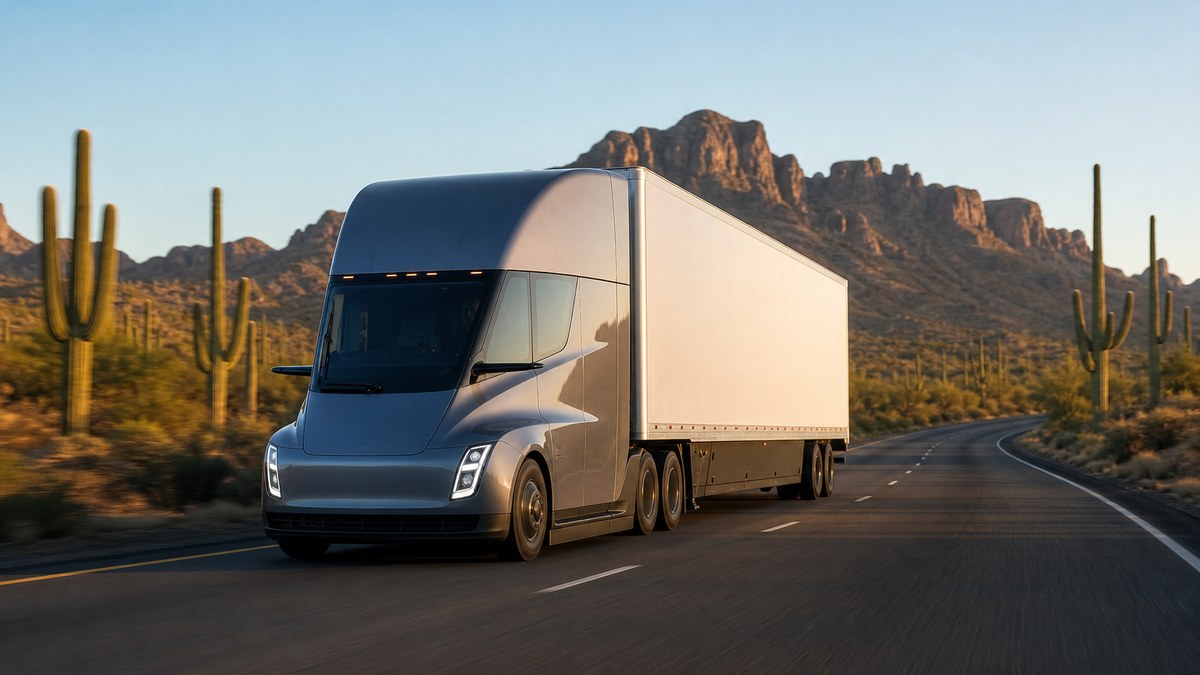
That leaves Arizona as a customer market rather than a production base for electric Class 8 trucks. Its advantages are real: Phoenix is one of the country's fastest-growing logistics hubs, and fleets running regional routes in heat and steady weather are good candidates for battery trucks. The obstacles are charging, as above, and grid capacity in fast-growing utility territories.
There is also a quieter Tesla-Arizona connection. On October 6, 2026, ContourGlobal broke ground on Project Sterling, a 450 MW (AC) solar and 1.4 GWh battery project about 20 miles north of Lake Havasu City in Mohave County. Tesla signed a long-term power purchase agreement for about 1 TWh a year, roughly 90% of the expected output, according to Electrek. The project is expected online in 2028, will employ about 400 construction workers, and connects to the Western Area Power Administration grid with rights into California's market. It is not tied to the Semi specifically, but it shows Tesla buying large amounts of desert clean power as its factories and charging grow.
Nevada builds the trucks; Arizona may end up being where the business case is tested hardest. Long, hot, flat freight lanes like I-10 are ideal for battery trucks on paper, but one planned Megacharger site for a state of more than seven million people is not a network. If Pilot or Tesla add Phoenix and Tucson sites, and if Arizona utilities offer workable demand-charge rates for depot charging, Arizona fleets could become some of the Semi's most important early adopters. Until then, the region's electric freight story is lopsided.
Who is buying the Tesla Semi?
Customer logos at the September 24 event included PepsiCo, DHL, US Foods, ABF, Einride, IMC Logistics and WattEV, according to Electrek. Two larger orders stand out:
- Einride: a 500-truck order placed in August 2026.
- ZET SCALE: on September 22, 2026, the Zero-Emission Truck Shipper-Carrier Alliance Leading Electrification, organized by Catalyst Mobility and Smart Freight Centre, named Tesla primary supplier for 2,500 battery-electric Class 8 trucks. Electrek noted that this single order would nearly double the number of electric Class 8 trucks on U.S. roads. Tesla has not said how many are destined for Europe.
Tesla also says it will use Semis to haul its own freight. For Europe, Priestley said at IAA Transportation in Hannover in September that customer demonstrations are planned for the first half of 2027 and first deliveries by the end of 2027. The first European trucks will be built in Nevada, and Tesla has not decided whether to build a European plant, according to FreightWaves. That makes Storey County, for now, the only factory in the world building the Semi.
How does it compare with other electric trucks?
| Truck | Stated range | Peak charging | Notes |
|---|---|---|---|
| Tesla Semi Long Range | 500 miles at 82,000 lb | 1.2 MW | Built in Nevada; price not official |
| Tesla Semi Standard Range | 325 miles at 82,000 lb | 800 kW | Lighter, under 20,000 lb curb weight |
| Freightliner eCascadia | Up to 230 miles | 270 kW | In production |
| Volvo VNR Electric | Up to 275 miles | 250 kW | In production |
| Windrose R700 | 200–450 miles | Not compared here | Plans U.S. assembly by end of 2026 |
Competitor figures are as compiled by The Weekly Driver from manufacturer data. On stated range and charging power, the Semi is well ahead of established truck makers. The question for fleets is whether Tesla can deliver in volume, support trucks with service networks in regions like the Mountain West, and hold prices.
What about policy and regulation?
The policy backdrop has shifted against mandates. EPA finalized Phase 3 heavy-truck greenhouse-gas standards in March 2024 and repealed them in February 2026. California withdrew its federal waiver request for Advanced Clean Fleets in January 2025, and its Air Resources Board voted in September 2025 to repeal the private-fleet, high-priority and drayage sections of the rule. Congress voted in 2025 to void the federal waiver for California's Advanced Clean Trucks rule. Government-fleet requirements in California still took effect on September 10, 2026.
In practice, that means the Semi will mostly have to win on economics rather than regulation. High diesel prices help; cheap Nevada electricity helps more. That is why the cost table above matters more than any mandate.
What should Nevada and Arizona watch next?
- Real delivery numbers. Tesla's Q4 2026 report (expected in January 2027) is the first chance to see whether it breaks out Semi production or deliveries.
- The 4680 factory in Nevada. Whether Tesla confirms the output of the planned 100 GWh cell plant, and whether dry-electrode production moves to Nevada.
- Jobs. Whether the "more than 3,000" jobs tied to the Semi ramp show up in Storey and Washoe County employment data.
- Charging in Arizona. New Megacharger or Pilot sites along I-10 and I-17, and utility rates for heavy-truck depot charging.
- The grid. Megawatt chargers and battery factories add load in a region already planning for AI data centers. Northern Nevada's power supply will be part of this story.
- Price and warranty. Tesla has still not published either; fleet buyers will want both.
For context on the region's other big manufacturing build-out, see our explainer on TSMC Arizona and the Phoenix chip cluster, and our earlier look at Tesla's "flying" Roadster and what is really taking off in Nevada and Arizona.
Building electric trucks, charging or batteries in Nevada or Arizona?
SHYNE covers the technology and energy projects reshaping the desert Southwest. Send us your story, project or announcement.
Email hgm@shyneltd.comFrequently asked questions
Where is the Tesla Semi made?
In a dedicated Semi factory next to Gigafactory Nevada on Tahoe-Reno Industrial Center land in Storey County, near Sparks. Tesla says it is the only plant building the Semi, including the first trucks for Europe.
When did Tesla Semi volume production start?
The first truck came off the high-volume line in April 2026, and Tesla held its volume-production launch event for customers on September 24, 2026.
How many Semis can the Nevada factory build?
Tesla's Semi chief gave a design capacity of 50,000 trucks a year at the launch. Tesla's Q3 2026 report lists 25,000 of installed annual capacity. Tesla has not disclosed how many trucks it has actually produced.
What battery does the production Tesla Semi use?
Tesla's own 4680 cylindrical cells, replacing the supplier 2170 cells used in earlier trucks. A CARB filing lists 548 kWh for the Standard Range and 822 kWh for the Long Range.
How far can the Tesla Semi go on a charge?
Tesla rates the Standard Range at 325 miles and the Long Range at 500 miles at a full 82,000 lb, using 1.7 kWh per mile. DHL reported 388 miles on one charge at 75,000 lb.
How much does a Tesla Semi cost?
Tesla has not published an official price. Electrek reported customer quotes of about $290,000 for the Long Range and about $260,000 for the Standard Range in 2026.
Is it cheaper to run a Semi than a diesel truck in Nevada?
On energy cost alone, very likely at current prices. One September 2026 calculation put the Semi at about $0.165 per mile on Nevada commercial power versus roughly $0.98 for diesel, before demand charges and charging losses.
Are there Tesla Semi chargers in Arizona?
Tesla's March 2026 map showed one planned Megacharger site in Arizona and none reported operating. Pilot's Tesla Semi charging program covers Nevada, California, New Mexico, Texas and Georgia, but not Arizona.
How many jobs does the Semi factory create?
Tesla's Semi lead attributes more than 3,000 jobs to the Semi ramp. Tesla's 2023 announcement said the $3.6 billion expansion, including a 4680 cell factory, would add 3,000 jobs. No independent count has been published.
What happened to Nikola's Arizona truck factory?
Nikola filed for bankruptcy in February 2025, and Lucid bought its Coolidge, Arizona facilities at auction in April 2025 for about $30 million.
Keep reading
Sources
- Electrek, Tesla Semi finally enters volume production, 7 years behind schedule (Sept. 25, 2026).
- FreightWaves, Tesla Semi enters volume production as 2027 rollout approaches (Oct. 2026, on Tesla's Q3 2026 results).
- The Weekly Driver, Tesla Semi factory opens as diesel hits a record $6.53 (Sept. 2026).
- autoevolution, Tesla Semi enters volume production with significant technical changes (Sept. 2026).
- Tesla, Continuing our investment in Nevada (Jan. 24, 2023).
- Electrek, Tesla Semi: first truck rolls off high-volume production line (April 29, 2026).
- IAA Transportation, Tesla identifies 66 locations for its Semi Megacharger network (March 4, 2026).
- CDLLife, Pilot to build Tesla Semi charging stations along I-5, I-10 and other corridors (Jan. 2026).
- Not a Tesla App, Tesla's dry cathode breakthrough (May 25–26, 2026).
- Electrek, Tesla's next big clean energy source is rising in the Arizona desert (Oct. 9, 2026).
- Electrek, Lucid acquires Nikola's factory and some assets (April 10, 2025); Drive Tesla Canada, Lucid acquires Nikola's Arizona facilities for $30 million.
SHYNE reports on technology and energy for general information. Specifications, capacities, prices and timelines are as stated by the companies and sources listed and may change. Nothing here is investment advice.