Solar and battery megaprojects in Nevada and Arizona: what's built, what's coming and what it costs
Gemini, Sierra Solar, Escape, Libra, Project Sterling and a 2,000 MW proposal near Pyramid Lake: the desert Southwest is building some of the largest solar-plus-storage plants in the country. Here is what is operating, what is under construction, why prices are rising, and what it means for your power bill.
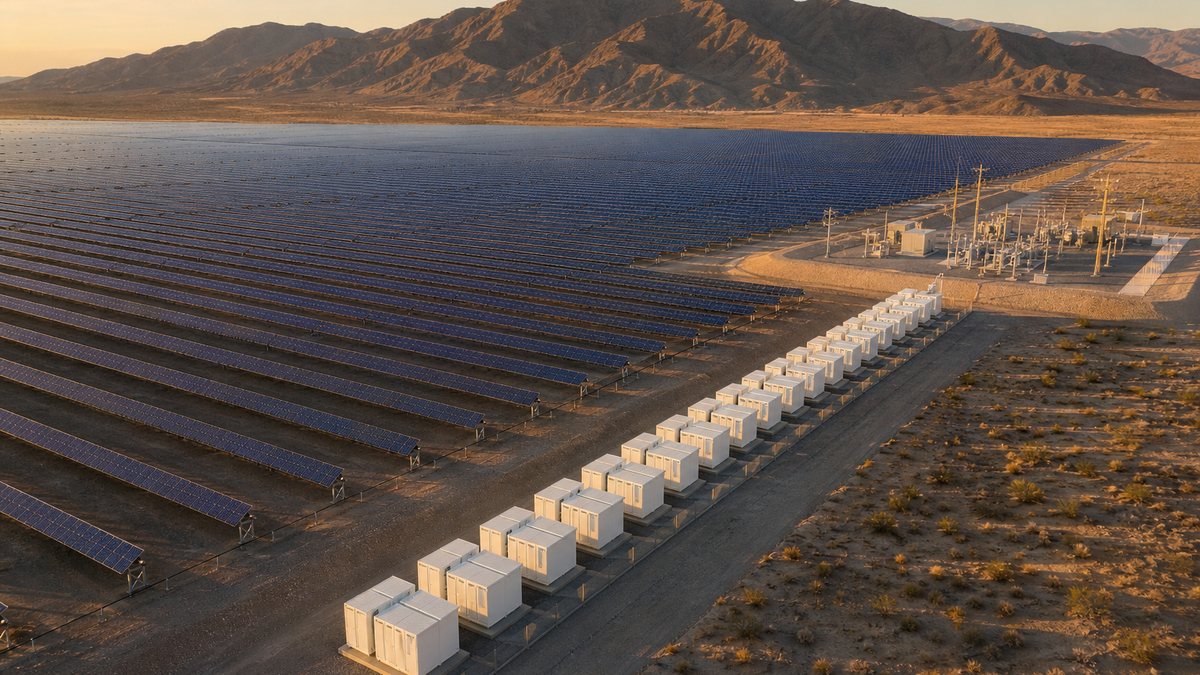
Nevada and Arizona are pairing giant solar farms with four-hour batteries so desert sunshine can cover the evening peak. Nevada's 690 MW Gemini plant is running, NV Energy's 400 MW Sierra Solar is almost done, and Arizona added more than 6.2 GWh of batteries in a single quarter in 2026. New contracts, though, now cost more.
- Arizona's battery boom: Arizona added more than 6.2 GWh of energy storage in Q2 2026, the strongest single-state quarter on record, and overtook Texas for the first half of 2026 with a 27% share of U.S. additions (SEIA/Benchmark via KTAR, Sept. 4, 2026).
- Nevada's flagship: Gemini, north of Las Vegas, has 690 MWac of solar and a 380 MW / 1,400 MWh battery under a 25-year NV Energy contract; it reached commercial operation in July 2024 (PV Tech, July 19, 2024).
- Utility-owned: NV Energy's $1.5 billion Sierra Solar in Churchill County (400 MW solar, 1,600 MWh battery) brought its battery online on March 20, 2026 and is tracking ahead of an April 2027 finish (IESNA, June 21, 2026).
- Big new Arizona build: ContourGlobal started construction on Project Sterling in Mohave County in October 2026: about 509 MWp of solar and 1.4 GWh of batteries, with Tesla buying about 1 TWh a year (Solar Power World, Oct. 8, 2026; APPA, July 29, 2026).
- Prices are rising: solar-plus-storage offers in NV Energy's 2026 resource plan averaged about $114/MWh, up from about $94/MWh for the projects proposed in 2024, as reported from the utility's filing (Oct. 2026).
Drive Interstate 15 north of Las Vegas, or U.S. 95 toward Tonopah, or almost any highway west of Phoenix, and you will pass something that did not exist a decade ago: thousands of acres of tracking solar panels, often with rows of white shipping-container-sized batteries along one edge. These are solar-plus-storage plants, and the desert Southwest has become one of the most important places in the country to build them.
The logic is simple. Nevada and Arizona have some of the best sunshine in North America, a lot of open land, and fast-growing electricity demand from new homes, factories, chip fabs and data centers. But demand peaks in the early evening, when air conditioners are still running and the sun is going down. Batteries solve that mismatch: they charge at midday when solar is plentiful and discharge for roughly four hours after sunset. That is why almost every big solar plant planned in the region now comes with storage attached.
This guide walks through the largest projects, separates what is operating from what is only proposed, and explains why the price of new contracts has climbed. It builds on our coverage of AI data centers and the power fight in Nevada and Arizona and Nevada's geothermal race, because the same demand surge is driving all three stories.
What counts as a solar-plus-storage megaproject?
There is no official definition, but in industry coverage a "megaproject" usually means a plant of several hundred megawatts or more. For scale: one megawatt of solar in the desert produces roughly enough energy over a year for a couple of hundred homes, and a 1,600 MWh battery, like the one at Sierra Solar, can deliver 400 MW for about four hours.
Two numbers matter for a battery. Power (MW) is how fast it can deliver electricity; energy (MWh) is how long it can keep going. A "400 MW / 1,600 MWh" system is a four-hour battery. Nearly all of the large batteries in Nevada and Arizona are lithium-ion and sized at about four hours, because that matches the evening peak and because federal tax credits and utility contracts have been written around it.
The projects also differ in who owns them. Some are built by independent developers and sell power to a utility under a 20- or 25-year power purchase agreement (PPA). Others, like Sierra Solar, are owned by the utility itself and paid for through customer rates. A growing number sell to private buyers, such as casinos on the Las Vegas Strip, Tesla, or California community power agencies.
Which big solar and storage plants are already running in Nevada?
Gemini is the landmark. Developed by Quinbrook Infrastructure Partners and Primergy Solar on federal land in Clark County, it pairs 690 MWac (966 MWdc) of solar with a 380 MW / 1,400 MWh battery. It was approved by the U.S. Department of the Interior in 2020, financed with nearly $2 billion in 2022, and reached commercial operation in July 2024, selling to NV Energy under a 25-year contract (PV Tech, July 19, 2024). When it came online it was described as the largest co-located solar and battery plant in the U.S.
Escape, in Lincoln County, is a different model. Reno-based Estuary Power built 185 MW of solar and 400 MWh of batteries and sells the output directly to Las Vegas customers: 115 MW of solar plus the full 400 MWh battery go to MGM Resorts under a 25-year PPA, and the remaining 70 MW goes to Overton Power District No. 5, Caesars Entertainment and Wynn Las Vegas. Deliveries began in June 2025 and the final phase was completed in January 2026, financed with a $340 million package (PV Tech, Jan. 21, 2026). Tesla supplied the battery system.
Sierra Solar, NV Energy's own project in Churchill County east of Reno, is nearly finished. The $1.5 billion plant has 400 MW of solar and a 1,600 MWh battery on 6,787 acres, with Kiewit as general contractor. Its battery came online on March 20, 2026, and the company said the project was on track to finish ahead of its April 2027 schedule, at or under budget despite tariff swings that added "tens of millions of dollars" in costs (IESNA, citing Northern Nevada Business Weekly, June 21, 2026). It feeds the Tahoe Reno Industrial Center, home to large data centers and battery plants, over the existing Tracy–Valmy 345 kV line.
| Project (Nevada) | Solar / storage | Status and source |
|---|---|---|
| Gemini, Clark County | 690 MWac / 380 MW, 1,400 MWh | Operating since July 2024; NV Energy 25-yr PPA (PV Tech) |
| Escape, Lincoln County | 185 MW / 400 MWh | Complete Jan. 2026; MGM, Caesars, Wynn, Overton PD (PV Tech) |
| Sierra Solar, Churchill County | 400 MW / 1,600 MWh | Battery online March 2026; full completion due by April 2027 (IESNA) |
| Dry Lake East, Clark County | 200 MW / 200 MW, 800 MWh | Approved Dec. 2024; commencement Dec. 2026 (Energy-Storage.news) |
| Boulder Solar III, Boulder City | 127.9 MW solar + storage | Approved Dec. 2024; COD June 2027 (Energy-Storage.news) |
| Libra Solar, Mineral County | Up to 700 MW / 700 MW, 2,800 MWh | Approved; BLM amendments cleared Dec. 15; >$2.33B (Solar Builder) |
| Winston Energy, Lyon County | 400 MW / 400 MW, 1,600 MWh | Two 25-yr NV Energy PPAs; COD Oct. 2029 (PV Tech, Aug. 19, 2026) |
| Juniper Peak and Amber Flats, Washoe/Churchill | 1,000 MW each + batteries | Proposed; applications at PUCN; target 2030 (Nevada Independent, Oct. 9, 2026) |
What is being built next in Nevada?
The next wave came out of NV Energy's 2024 integrated resource plan, which the Public Utilities Commission of Nevada (PUCN) approved on Dec. 20, 2024. Regulators backed three solar-plus-storage contracts plus Fervo's 115 MW Corsac geothermal plant, while also approving two 200 MW gas turbines at North Valmy estimated at $575.3 million over objections from clean-energy groups (Energy-Storage.news).
- Libra Solar (Arevia Power): up to 700 MW of solar and a 700 MW / 2,800 MWh battery on about 5,778 acres of Bureau of Land Management land in Mineral County, roughly 20 miles south of the Fort Churchill substation near Yerington. Cost: more than $2.33 billion. The Interior Department issued its record of decision in September 2024; after a five-month freeze, BLM approved project amendments on Dec. 15, clearing the way for construction in 2026. The original target was completion by the end of 2027, and no new date has been announced (Solar Builder).
- Dry Lake East (NextEra Energy Resources): 200 MW of solar and a 200 MW / 800 MWh battery in Clark County, with contract commencement in December 2026.
- Boulder Solar III (174 Power Global): 127.9 MW of solar and storage near Boulder City, scheduled for June 2027.
In August 2026, EDF power solutions signed two 25-year PPAs with NV Energy for Winston Energy in Lyon County: 400 MW of solar plus a 400 MW / 1,600 MWh battery, with commercial operation expected in October 2029 (PV Tech, Aug. 19, 2026). EDF is in the middle of selling its North American business to KKR, a deal that was not yet complete at the time.
The biggest new proposals are in northern Nevada. In October 2026, Colorado-based Scout Clean Energy filed applications with the PUCN for two 1,000 MW solar farms with batteries: Juniper Peak on about 17,700 acres in Little Valley, southeast of Pyramid Lake, and Amber Flats on about 17,100 acres in Churchill County. Each is listed with a 2030 target, and together they would be almost three times the size of Gemini. Desert conservation group Basin and Range Watch has criticized the plans (The Nevada Independent, Oct. 9, 2026). These are applications, not approved projects.
Nevada's solar story has quietly shifted north. Gemini and the early Strip-focused plants were built to serve Las Vegas; Sierra Solar, Libra, Winston, Juniper Peak and Amber Flats are aimed at the Reno–Tahoe industrial corridor, where data centers and battery factories are pushing demand up fastest. That makes transmission, not panels, the real bottleneck. Every 1,000 MW proposal in the north assumes the Greenlink lines get built on time. Watch the Greenlink West restart and the PUCN's ruling on the 2026 resource plan before treating any of the 2029–2030 dates as firm.
Which Arizona projects are the biggest?
Arizona's story is less about one flagship plant and more about volume. According to the SEIA and Benchmark Mineral Intelligence Q3 2026 storage outlook, Arizona added more than 6.2 GWh of storage in Q2 2026, the strongest single-state quarter on record, and overtook Texas for the first half of the year with a 27% share of U.S. additions (KTAR/Phoenix Business Journal, Sept. 4, 2026). Citing U.S. Energy Information Administration data from May 2026, an industry column puts Arizona's utility-scale battery capacity above 6,000 MW, up from about 3,200 MW in 2025 (AZ Big Media, sponsored, Nov. 20, 2026).
Project Sterling in Mohave County, near Topock and Kingman along historic Route 66, is the largest new build. ContourGlobal describes it as about 509 MWp / 450 MWac of solar with a 360 MW / 1.4 GWh battery and expected output above 1.1 TWh a year. Tesla signed a PPA in July 2026 for about 1 TWh a year, around 90% of the plant's output (APPA, July 29, 2026). Construction started in October 2026 with more than 760,000 modules and over 300 battery containers planned (Solar Power World, Oct. 8, 2026). Commercial operation is targeted for 2028. The plant connects to the Western Area Power Administration (WAPA) grid and holds firm transmission rights into California's grid, where it will be "pseudo-tied" to serve Tesla.
Pioneer Clean Energy Center, developed by BrightNight with Cordelio Power, pairs 300 MW of solar with 1,200 MWh of Fluence batteries using U.S.-made cells. Arizona Public Service (APS) is buying the full output, and commercial operation is expected by April 2027 (Solar Power World, Jan. 15, 2026).
Sun Pond, in Maricopa County, came online in May 2026: 111 MW of solar and 340 MWh of storage built by McCarthy for Longroad Energy. Its power goes to two California buyers, Ava Community Energy and San José Clean Energy. It is part of Longroad's Sun Streams complex, nearly 1.6 GW across four projects, which the developer says has delivered more than $300 million in benefits to Arizona schools and communities through state land leases and taxes (Solar Power World, May 5, 2026).
| Project (Arizona) | Solar / storage | Buyer, status and source |
|---|---|---|
| Project Sterling, Mohave County | ~509 MWp (450 MWac) / 360 MW, 1.4 GWh | Tesla (~1 TWh/yr); construction began Oct. 2026; COD target 2028 (APPA, Solar Power World) |
| Pioneer Clean Energy Center | 300 MW / 1,200 MWh | APS; COD by April 2027 (Solar Power World) |
| Sun Pond, Maricopa County | 111 MW / 340 MWh | Ava Community Energy, San José Clean Energy; online May 2026 |
| Sun Streams complex | ~1.6 GW across four projects | Longroad Energy; includes Sun Pond (Solar Power World) |
| Project New Horizon (SRP/ESS) | 5 MW / 50 MWh iron-flow pilot | Terminated Nov. 5, 2026 (SRP) |
Why is Arizona building so many batteries?
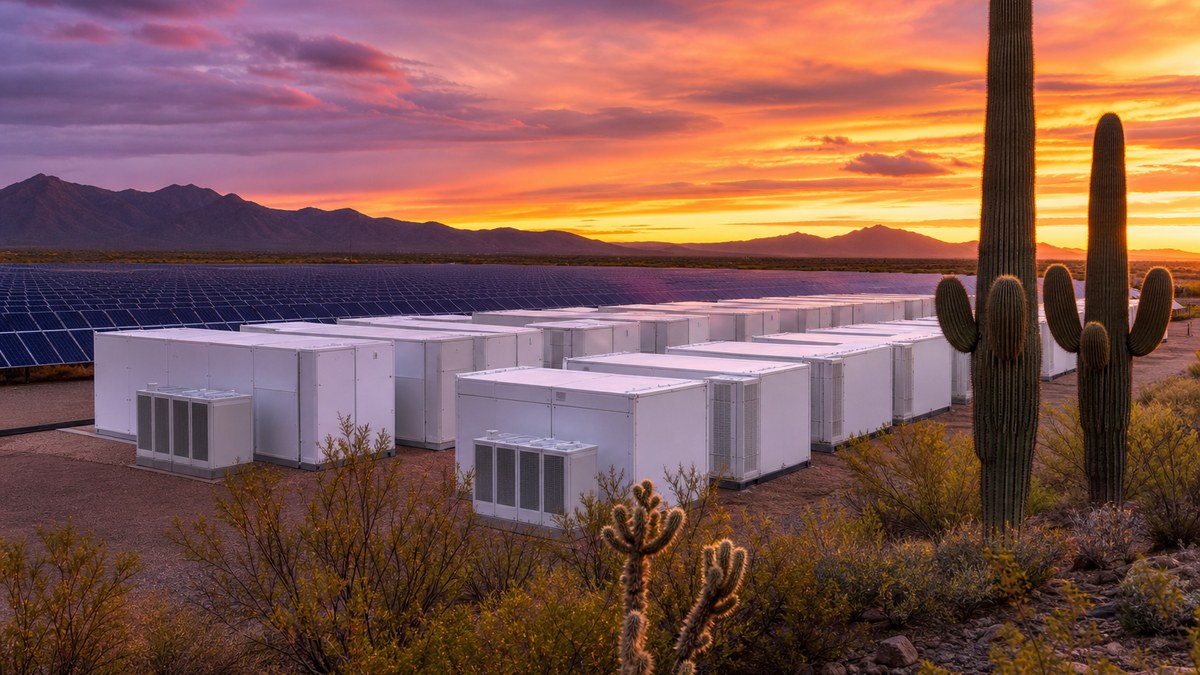
Because its utilities are running short of capacity at the hottest hours of the year, and batteries are the fastest thing to build. Salt River Project's planning update in July 2026 projected Greater Phoenix industrial power demand rising 50% in four years, and SRP is seeking to expand its generating capacity by nearly a third; APS is planning for 40% load growth over five years (as summarized in AZ Big Media, Nov. 20, 2026). A utility-scale battery can go from contract to operation in roughly 14 to 24 months, according to the same industry column, compared with many years for a new gas or nuclear plant.
Much of that growth comes from the industries we have covered on SHYNE: TSMC's Phoenix chip fabs, battery and EV factories, and hyperscale data centers in the West Valley. Batteries let utilities soak up cheap midday solar and release it during the 5 p.m. to 9 p.m. window when the grid is most stressed.
Not every storage bet works out. SRP's 50 MWh iron-flow pilot with ESS Tech, announced in October 2025 as a 10-hour "long-duration" test at the Copper Crossing site in Florence, now carries a note that the project was terminated on Nov. 5, 2026 (SRP newsroom). SRP still lists about 1,300 MW of storage in its fleet, including 1,100 MW of batteries across eight facilities and 200 MW of pumped hydro.
Why are new solar-plus-storage contracts getting more expensive?
For years, desert solar kept getting cheaper. That trend has reversed, at least for new contracts. As reported from NV Energy's 2026 resource-plan filing (Volume 8), 11 solar-plus-battery offers totaling 4,370 MW averaged about $113.89/MWh, compared with about $94/MWh for the three solar-plus-storage projects proposed in 2024. Three geothermal offers totaling 180 MW came in lower, at about $105.56/MWh (ZeroHedge analysis of the filing, Oct. 2026). Boulder Solar III's levelized price was reported to have risen from about $85/MWh to about $125/MWh, which the analysis attributes to permitting delays, land carrying costs, higher financing costs and tariffs.
These figures come from a secondary analysis of the filing rather than a regulator's decision, and they are developer offers, not final contract prices. But the direction matches what developers say on the ground: tariffs on imported equipment, higher interest rates and longer permitting have all pushed costs up. Even NV Energy's Sierra Solar reported tariff volatility adding tens of millions of dollars.
Federal tax policy adds a deadline. Under the 2025 federal budget law, wind and solar projects that did not begin construction by July 4, 2026 must be placed in service by the end of 2027 to keep their tax credits, while storage and geothermal keep credits for construction starting through 2033 (as summarized in the same analysis). That is one reason developers rushed to start construction this year, and why stand-alone batteries may look more attractive than new solar after 2027.
The cost reversal matters more than any single project. A solar-plus-storage offer at about $114/MWh is still competitive with new gas once fuel risk is counted, but it is no longer the obvious bargain it was in 2020. That changes the conversation in Carson City and Phoenix: utilities will argue for owning more of the build themselves, as NV Energy did with Sierra Solar, and regulators will be asked to compare solar, geothermal, gas and batteries on firm-capacity value, not just headline price per megawatt-hour. Expect the 2026 Nevada resource-plan ruling to be the first big test.
Will these projects lower my power bill?
Not directly, and not right away. Solar and batteries reduce fuel use, and in Nevada fuel and purchased-power costs flow through to customers without utility profit. On Nov. 17, 2026, NV Energy asked regulators to lower Southern Nevada rates from Jan. 1, 2027, a cut of about $11.17 a month, or 7.95%, for a typical residential customer, reflecting lower fuel and purchased-power costs (FOX5 and News 3 Las Vegas, Nov. 17, 2026). The filing does not attribute the decrease to any specific solar project, and it still needs PUCN approval.
On the other side of the ledger, utility-owned projects like Sierra Solar and new transmission lines are paid for through base rates over decades. Whether bills go up or down over time depends on how much the region builds, how fast demand grows, and who pays for the new grid: households, or the data centers and factories driving most of the growth. That cost-allocation fight is the same one we described in our data center coverage, and it is likely to come up in the 2027 Nevada Legislature and at the Arizona Corporation Commission.
What could slow the buildout?
- Transmission: NV Energy's Greenlink West line (Las Vegas to Yerington) has been paused for more than a month after a seven-day prayer by Yerington Paiute tribal members and Indigenous activists in early October at an area the tribe holds sacred on BLM land (KNPR, Nov. 16, 2026). Many northern Nevada solar projects depend on Greenlink.
- Federal land and permitting: most big Nevada plants sit on BLM land. Libra's five-month freeze shows how federal reviews can stall even approved projects. In November 2026, the U.S. Senate advanced a bipartisan permitting reform bill by 73-25, with both Nevada senators voting yes (KNPR, Nov. 10, 2026).
- Tariffs and supply chains: imported panels, cells and battery components face higher duties, which is one reason developers like BrightNight and Fluence are advertising U.S.-made battery content.
- Local opposition: desert-habitat groups have challenged large solar footprints, and the 17,000-acre-plus Scout proposals near Pyramid Lake have already drawn criticism.
- Tax-credit deadlines: solar that misses the end-2027 in-service deadline without a 2026 construction start may lose credits, which could cancel marginal projects.
Nevada and Arizona compared
| Question | Nevada | Arizona |
|---|---|---|
| Landmark solar site | Gemini, 690 MW + 1,400 MWh (operating) | Longroad Sun Streams complex, ~1.6 GW across four projects |
| Biggest new build | Libra, up to 700 MW + 2,800 MWh | Project Sterling, ~509 MWp + 1.4 GWh |
| Main buyers | NV Energy, Strip casinos, data centers | APS, SRP, Tesla, California agencies |
| Storage trend | Large co-located batteries (4 hours) | National leader in 2026 storage additions |
| Key bottleneck | Transmission (Greenlink), BLM permits | Capacity shortfall at peak, land and interconnection |
| Next decision point | PUCN ruling on 2026 resource plan | APS/SRP procurement; new legislature in 2027 |
What to watch next
- The PUCN ruling on NV Energy's 2026 integrated resource plan, which will decide which of the 4,370 MW of solar-plus-storage offers move forward.
- Whether Greenlink West construction resumes, and on what timeline.
- Sierra Solar's full completion, possibly ahead of its April 2027 date, and any move on a second phase on adjacent land.
- First construction work at Libra Solar after the December BLM decision.
- Project Sterling's construction progress toward its 2028 target and the Pioneer Clean Energy Center's April 2027 start.
- Scout Clean Energy's Juniper Peak and Amber Flats applications at the PUCN.
- The next SEIA storage report, to see whether Arizona keeps its national lead.
Building solar, storage or transmission in Nevada or Arizona?
SHYNE covers the technology and energy shaping the desert Southwest. Send us your project, your data or your story tip.
Email hgm@shyneltd.comFrequently asked questions
What is the largest solar-plus-storage project in Nevada?
Among operating plants, Gemini in Clark County is the largest, with 690 MWac of solar and a 380 MW / 1,400 MWh battery. Larger projects have been approved or proposed, including Libra Solar in Mineral County (up to 700 MW of solar and 2,800 MWh of storage) and two 1,000 MW proposals near Pyramid Lake.
Why do new solar farms come with batteries?
Desert solar produces most power at midday, but demand peaks in the early evening. Batteries charge from solar during the day and discharge for about four hours after sunset, so the plant can help meet the evening peak instead of only adding power when it is already plentiful.
How much battery storage does Arizona have?
Arizona added more than 6.2 GWh of storage in the second quarter of 2026 alone, according to SEIA and Benchmark Mineral Intelligence. An industry column citing EIA data from May 2026 puts the state's utility-scale battery capacity above 6,000 MW, up from about 3,200 MW in 2025.
Who is buying the power from Project Sterling?
Tesla signed a power purchase agreement in July 2026 for about 1 TWh a year, roughly 90% of the plant's expected output. The plant is in Mohave County, Arizona, but holds transmission rights into the California grid to serve Tesla's needs there.
When will Sierra Solar be finished?
NV Energy's Sierra Solar in Churchill County had its 1,600 MWh battery online on March 20, 2026. The full 400 MW project was scheduled for April 2027, and the company said in June 2026 that it was on track to finish early.
Are solar-plus-storage prices going up in Nevada?
Yes, based on reported figures from NV Energy's 2026 resource plan. Solar-plus-storage offers averaged about $114 per MWh, versus about $94 per MWh for projects proposed in 2024. Tariffs, financing costs, land costs and permitting delays are the main reasons cited. These are offers, not final approved prices.
Will NV Energy bills go down in 2027?
NV Energy asked regulators on Nov. 17, 2026 to lower Southern Nevada rates from Jan. 1, 2027, by about $11.17 a month for a typical home, or 7.95%, due to lower fuel and purchased-power costs. The change still needs approval from the Public Utilities Commission of Nevada.
What is Greenlink West and why does it matter?
Greenlink West is a major NV Energy transmission line between Las Vegas and the Yerington area. Many northern Nevada solar and storage projects need it to move power. Construction was paused in October 2026 after Yerington Paiute tribal members held a prayer at an area they consider sacred.
Do these projects use public land?
Many do. Gemini and Libra are on Bureau of Land Management land, and the proposed Juniper Peak and Amber Flats projects would each use roughly 8,000 acres of public land along with private land. In Arizona, projects such as Longroad's Sun Streams lease Arizona State Land Department land.
Is SHYNE involved in these projects?
No. SHYNE is an independent tech and energy news site for Nevada and Arizona. We report on these projects from public filings, company announcements and news coverage, and we label company claims and targets as such.
Keep reading
Sources
- KTAR / Phoenix Business Journal, Arizona leads nation in battery storage growth, overtaking Texas (Sept. 4, 2026).
- PV Tech, Gemini, major solar-plus-storage project in Nevada, reaches commercial operations (July 19, 2024).
- PV Tech, Estuary Power completes final phase of Escape solar-plus-storage project in Nevada (Jan. 21, 2026).
- IESNA, NV Energy's $1.5B Churchill County solar+storage project on target for early delivery (June 21, 2026).
- Energy-Storage.news, NV Energy receives green light for 1GW+ of storage (Dec. 2024).
- Solar Builder, BLM unfreezes Libra Solar to allow construction start in 2026.
- PV Tech, EDF signs PPAs with NV Energy for 400MW solar-plus-storage project in Nevada (Aug. 19, 2026).
- The Nevada Independent, Two massive solar plants proposed for Washoe's Pyramid Lake area (Oct. 9, 2026).
- Solar Power World, Solar + storage construction starts on Project Sterling in Arizona (Oct. 8, 2026).
- American Public Power Association, ContourGlobal unveils execution of PPA with Tesla for Arizona solar and storage project (July 29, 2026).
- Solar Power World, Construction underway on 300-MW solar + storage project in Arizona (Jan. 15, 2026).
- Solar Power World, Arizona solar + storage project comes online to benefit California utilities (May 5, 2026).
- AZ Big Media (sponsored), Arizona's energy future increasingly runs through battery energy storage (Nov. 20, 2026).
- SRP, SRP and ESS announce new 50 MWh long duration energy storage pilot project (Oct. 9, 2025; marked terminated Nov. 5, 2026).
- ZeroHedge, Geothermal just undercut solar-plus-storage in sunny Nevada (Oct. 2026; analysis of NV Energy 2026 IRP Volume 8).
- FOX5 Las Vegas, NV Energy seeks lower electric rates for Southern Nevada customers in 2027 (Nov. 17, 2026).
- News 3 Las Vegas, NV Energy seeks Southern Nevada rate cut starting in 2027 (Nov. 17, 2026).
- KNPR / Mountain West News Bureau, Indigenous protests pause a high-power energy transmission project in Nevada (Nov. 16, 2026).
- KNPR, Energy permitting bill, Nevada gas prices and Blue Diamond trail (Nov. 10, 2026).
SHYNE reports on technology and energy for general information. Project sizes, costs, timelines and output figures from developers, utilities and buyers are company statements and targets and may change. Resource-plan prices are developer offers as reported from public filings, not approved contract prices. Nothing here is investment advice.